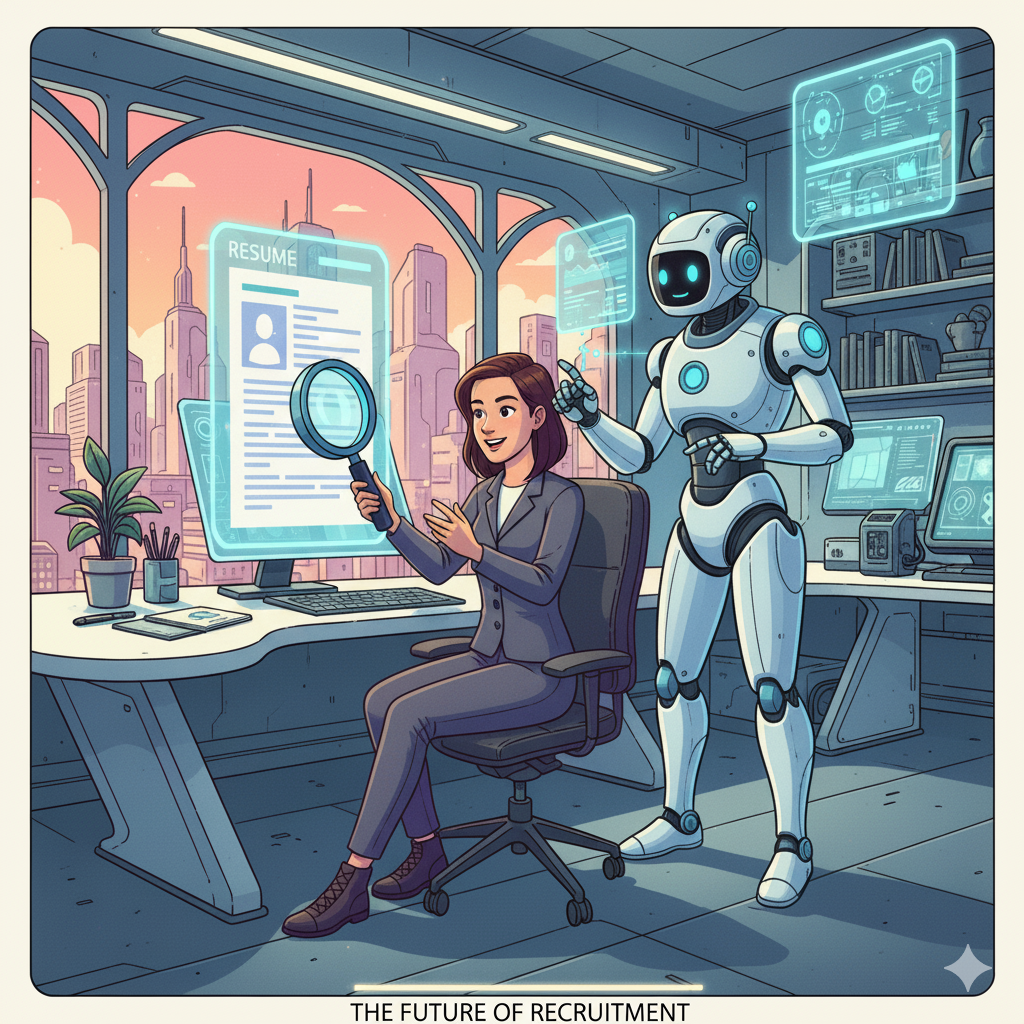
Once upon a time, there was an HR manager named Sarah. She was very good at her job, but she felt like she was always fighting a losing battle. Her days were a blur of paperwork. She was sifting through resumes, scheduling interviews, and answering the same questions about benefits over and over again. She wanted to spend more time with her employees. (AI Agents in HR)
Also, She wanted to help them with their careers and make them feel supported. However, she was always too busy with administrative tasks. She felt like a paper pusher, not a people person. Her HR department felt more like a call center than a place of support. The truth is, Sarah was struggling with a common problem. She was working in a world that had not yet been touched by AI. She was also trying to do the work of a whole team on her own. (AI Agents in HR)
Today, however, Sarah has a new partner. It’s a powerful new technology that helps her with her work. It’s called an AI agent. The AI Agents in HR have completely changed her workflow. They have become her employee co-pilot. They handle all the boring tasks. This frees her up to focus on what she does best: building relationships and helping people. In fact, she now sees AI not as a replacement for her job. She sees it as a powerful tool. In this article, you will also discover how to use AI to make your work easier and more fun. We’ll explore how these tools work. We will also look at the top tools you should be using. By the end, you will be ready to transform your HR department, just like Sarah.
AI for Talent Management: Your Super-Smart Recruiter (AI Agents in HR)
Finding great people for a job has always been a challenge. It can take a lot of time and effort. A large part of this challenge is sifting through applications to find a few great candidates. This is where AI for talent management really shines. An AI agent can handle the tedious parts of hiring, which frees up recruiters to focus on what matters most: building relationships with people.
Here are some of the ways AI agents are helping with hiring:
- Smarter Screening: An AI agent can look through hundreds of resumes in seconds. It looks for skills, experience, and keywords. It then gives you a list of the best candidates. This is much faster and fairer than a human doing it manually.
- Automated Scheduling: You know how hard it is to schedule a meeting with a lot of people. An AI agent can do this for you. It looks at a recruiter’s calendar and a candidate’s availability. It then finds a time that works for everyone and sends out an invitation. This saves a lot of time and effort.
- Faster Onboarding: Onboarding is the process of getting a new employee up to speed. An AI agent can automate this process. It can send a new employee welcome emails and training materials. It can also help them with all the paperwork. This makes the first few days much smoother for everyone.
The impact of this is huge. According to a Workday report, one recruitment agent can save a human recruiter an entire workday every week. This allows the recruiter to spend more time building relationships.
AI for Employee Engagement: A New Way to Connect
Once an employee is hired, the work of HR is not done. Your next job is to keep that employee happy and engaged. This is one of the most important jobs of HR. An unhappy employee might leave your company. A happy employee will stay, and they will also do better work. This is where AI for employee engagement can be a great help. An AI agent can help you understand what employees are thinking and feeling. It can also help you give them the support they need.
Here are some ways AI agents are helping with employee engagement:
- Instant Answers: Employees often have questions about benefits, vacation time, or company policy. An AI chatbot can answer these questions instantly, 24/7. This helps employees get the information they need without having to wait. It also frees up the HR team.
- Sentiment Analysis: An AI agent can look at employee feedback from surveys and internal communication. It can then figure out what employees are feeling. This helps you spot problems early, before they become a big issue. For example, the AI might find that a lot of employees are talking about burnout. The HR team can then step in and help.
- Personalized Learning: Every employee has different skills. They also have different career goals. An AI agent can look at an employee’s skills and goals. It can then suggest learning materials and courses that are a perfect fit. This helps employees feel like their company cares about their growth.
According to a Gartner report, two-thirds of HR leaders trust that AI agents will act in ways that benefit the employee experience. This shows that AI is a great tool for building a positive and supportive workplace.
Real-World Applications of AI Agents in HR
Many of the world’s most innovative companies are already using AI agents to get ahead. These real-world examples prove that AI Agents in HR are not just a theory; they are a powerful tool.
Case Study 1: Unilever’s AI-Powered Screening
Unilever, a global company, was struggling with a high volume of job applications. They were also trying to hire a more diverse group of people. To solve this, they used an AI-driven screening tool. The AI looked at a candidate’s skills and potential. It did not look at a candidate’s name or other personal information. This helped them hire a more diverse workforce. It also made the hiring process much faster. This is a great example of how AI can be used to make hiring fairer and more effective.
Case Study 2: IBM’s “AskHR” Agent
IBM is a big company with a lot of employees. They needed a way for their employees to get answers to their HR questions quickly. So, they created an AI agent called “AskHR.” This agent is a chatbot that can answer a lot of questions about benefits, payroll, and company policy. This agent can answer questions from over 270,000 employees every day. This frees up the HR team to focus on more important work. It is a great example of how AI can be used to improve employee satisfaction.
Case Study 3: The Tech Company’s Talent Forecast
A tech company used to spend a lot of time finding new engineers. They also were struggling to keep their current engineers. They decided to use an AI tool to help them. The AI looked at a lot of data. It predicted which employees might leave the company soon. It also helped the company identify the skills they would need in the future. This allowed them to give their employees more opportunities. The AI also helped them find new talent. This saved the company a lot of money and time. This is a great example of AI for talent management in action.
Top AI Tools for Modern HR Professionals
The market is full of fantastic tools that can supercharge your HR department. Here are a few to get you started.
- Paradox (Olivia): This tool is an AI chatbot. She is a conversational assistant that helps with scheduling and answering a candidate’s questions. Olivia is a great tool for improving the candidate experience. Paradox.ai.
- Eightfold.ai: This is a powerful AI tool for talent management. It helps companies find candidates by matching their skills to a job. It also helps companies find people who are not actively looking for a new job. Eightfold.ai.
- Phenom: This platform uses AI to enhance the entire employee experience, from recruitment to career pathing. Its tools help automate the hiring process, and its analytics help HR teams make smarter decisions. Phenom.com.
- Wysa: Wysa is an AI chatbot that acts as a mental health assistant. It helps people with a lot of different things, including anxiety and depression. It’s a great tool for helping employees with their mental health. Wysa.com.
These tools are at the forefront of HR tech trends. They can help you take your HR department to the next level.
Conclusion: AI as a Partner, Not a Replacement
So, is AI going to replace HR professionals? The answer is no. Instead, AI is changing the job for the better. It is taking away the boring, repetitive work. This frees up HR professionals to be more creative and strategic. The future of HR is a partnership between human empathy and AI efficiency. The AI handles the data and the mundane tasks. The human handles the creative, emotional, and strategic parts of the job.
According to a McKinsey report, the most successful companies are the ones that redesign their workflows to include AI. This is a huge change. But it is not about replacing the human. It is about empowering the human. The HR professionals who learn to use AI as a partner will be the ones who stand out. They will be more productive. They will also be more creative. Also, They will be able to lead their teams more effectively and have a more enjoyable workflow.
Choosing an AI Assistant: A Guide to the Right AI Tool
AI Reasoning Trends: The Future of Problem-Solving