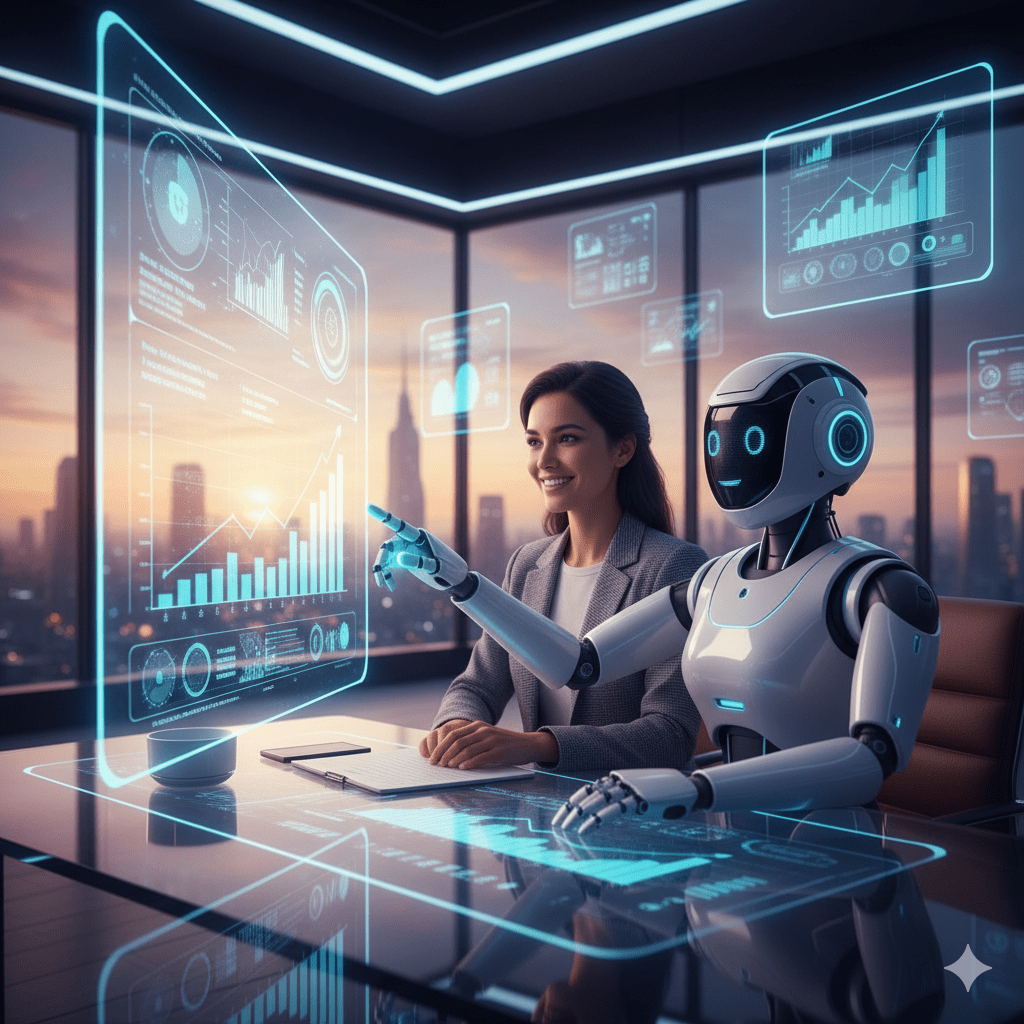
Imagine you’re a superhero with an amazing job: you help people find the things they love. You’re a digital marketer! Your superpower is showing people online ads for products and services that they might actually want to buy. But there’s a problem. The internet is a huge place with billions of people. It’s like trying to find one specific seashell on a beach that goes on forever. How do you know which person to show which ad? It’s a question that can keep even the smartest marketers up at night. (Artificial Intelligence and Machine Learning in Digital Marketing)
This is where your new sidekicks, artificial intelligence and machine learning in digital marketing, come to the rescue. Think of them as a team of super-smart robots. Artificial intelligence (AI) is the main robot that can do things, and machine learning (ML) is how that robot learns to get smarter and better at its job over time. They are the secret weapons that help digital marketers stop guessing and start knowing.
How to Build AI Workflows: Your Guide to a Smarter Business
We’ll follow the story of a marketer named Emily. Emily’s job was to sell running shoes online. She was smart and worked hard, but she was frustrated. She would show the same ad for her new running shoes to everyone, and most people would just ignore it. Also, She knew there had to be a better way to find the people who actually love to run. Her journey to discover the power of artificial intelligence and machine learning in digital marketing is a lot like yours will be.
AI Video Production Workflow: Your Guide from Script to Screen
The Problem: Too Many People, Not Enough Time (artificial intelligence and machine learning in digital marketing)
Emily’s biggest challenge was that she was guessing. She would try to show her shoe ads to people who liked sports, but that was a huge group. She didn’t know if a person was a serious runner, a weekend jogger, or just someone who liked watching football. Also, She spent hours every week trying to figure out which words to use in her ads and which images would work best. It was an endless cycle of trial and error. Her old way of doing things was costing her time and money, and she wasn’t seeing great results. The constant struggle to manually optimize her campaigns showed her why so many people are turning to AI in digital marketing.
She knew that if she could find a better way, her business would grow, and she could stop wasting her effort. She started to research how other people were solving this problem. This is when she first learned about the incredible potential of artificial intelligence and machine learning in digital marketing. She realized that while she was busy trying to find one seashell at a time, AI could look at the whole beach at once and tell her exactly where the best shells were.
Finding the Right People: Using AI for Audience Segmentation
The first thing Emily learned was how AI could help her find her perfect audience. This process is called “audience segmentation,” which just means dividing a big group of people into smaller, more specific groups. Before, Emily just had a group called “people who like sports.” Now, with her new AI helper, she could create groups like “people who ran a marathon last year,” “people who bought running shorts a month ago,” and “people who live near a park.”
The AI did this by looking at tons and tons of data. It analyzed what people searched for, what videos they watched, and which websites they visited. By looking for patterns that a human eye would never see, the AI could tell Emily, “Hey, these people are serious runners. They are the ones who will really love your new shoes.” For Emily, this was a game-changer. It proved that the role of AI in digital marketing was to find her ideal customer, not just guess who they might be.
Smarter Ads with an Even Smarter Brain: AI Digital Advertising
Once Emily knew who she was talking to, her next step was to make sure her ads were as good as possible. She learned about AI digital advertising, which is a special kind of advertising where the AI doesn’t just show an ad—it helps create it.
Emily used an AI tool that could write different headlines for her ads. She would give it a few key points about her new running shoes, and the AI would create ten different headlines in a matter of seconds. It was like having a team of copywriters working for her for free. The AI would also change her ad on its own, showing a picture of a man to men and a picture of a woman to women. It would even change the colors of the ad to see which ones worked best. All these tiny changes, which Emily would never have had time to do, were automatically done by the AI. This is a clear example of how AI driven digital marketing makes every ad work harder and smarter.
Real-World Case Studies: How Companies Use AI to Win (artificial intelligence and machine learning in digital marketing)
Many companies, both big and small, are already using machine learning in digital marketing to achieve amazing results. Here are three examples.
Case Study 1: The Fast-Food Chain and Personalized Offers
A big fast-food chain, let’s call them “Burger King,” wanted to send special offers to their customers. In the old days, they would send a coupon for a burger to everyone. But they noticed that some people only bought fries, and some people only bought drinks. They started using AI to analyze a customer’s past orders. When the AI noticed a person always bought a drink and fries, it would send them a special offer for a discount on a new drink or a side order. This use of AI for digital marketing made their customers feel seen and special, and it led to more sales because they were sending offers that people actually wanted.
Case Study 2: The E-commerce Giant and Predictive Analytics
An online retailer, “Amazon,” uses AI and machine learning in digital marketing to do something very clever: they predict what you will buy before you even know you want it. When you buy a book, their AI looks at what other people who bought that same book also bought. They use this information to recommend other books or items to you. It’s a huge part of how they make money. This isn’t just a guess; it’s a prediction based on billions of pieces of data. This use of digital marketing with AI helps them sell more and provides a better shopping experience for their customers.
Case Study 3: The Movie Studio and AI-Powered Trailers
When a big movie studio releases a new movie, they need to make sure their trailers reach the right people. A comedy movie trailer should go to people who like comedy, and a superhero movie trailer should go to people who love superheroes. They use AI to analyze what kind of videos people watch online. The AI can then figure out which type of trailer to show to each person. This is a very advanced use of AI in modern digital marketing because it makes sure that the right message gets to the right person at the right time, leading to more people buying movie tickets.
Top AI Tools for Your Digital Marketing Toolkit
Ready to get started? You don’t need to be a programmer to use these tools. Here are a few that can help you with your own AI driven digital marketing efforts.
- Jasper: This is a writing robot. You can give it a simple request, like “write a short ad about my new running shoes,” and it will create different versions for you to choose from. It is perfect for AI for content creation.
- HubSpot: This is a big platform that has many tools for marketers. It has a lot of built-in AI features that can help you with everything from writing emails to figuring out when the best time to post on social media is.
- Semrush: Semrush is a tool that helps you find the right words (keywords) to use in your ads and on your website. They use AI to find new words and phrases that people are searching for online.
- Google Analytics AI features: This tool from Google helps you understand what’s happening on your website. Its AI features can tell you, for example, which city your customers are from or which pages on your website are most popular. This is a great way to start using AI and machine learning in digital marketing because it’s built right into a tool you might already use.
How-To Tips: Building Your AI Digital Marketing Strategy
Getting started with a new technology can feel a little scary, but it doesn’t have to be. Just remember to start with one small step. Here is a simple plan to help you begin your journey with using AI in digital marketing.
Step 1: Find Your Biggest Problem (artificial intelligence and machine learning in digital marketing)
Think about the most frustrating part of your job. Is it writing emails? Or is it figuring out what to post on social media? Or maybe it’s knowing if your ads are working? Pick just one thing. For Emily, her biggest problem was knowing who her customers were. Once you know your problem, you can find a specific AI tool that solves it.
Step 2: Use One Tool to Solve One Problem
Don’t try to use all the tools at once. If your problem is writing emails, try a tool like Jasper. If your problem is knowing who your customers are, try a tool like HubSpot. This simple, focused approach is a great way to start with AI in digital marketing.
Step 3: Learn from the AI (artificial intelligence and machine learning in digital marketing)
Remember that the AI isn’t perfect. It’s a partner, not a boss. When the AI suggests a headline for an ad, read it and ask yourself, “Is this what a human would say?” You can learn a lot from the AI’s suggestions and get better at your own job. It’s a team effort. The human and the AI working together is the real magic.
The Future: AI is Your Marketing Partner (artificial intelligence and machine learning in digital marketing)
In the end, it’s important to remember that artificial intelligence and machine learning in digital marketing are not here to replace you. Instead, they are here to help you. They are the smart sidekicks that can do the boring, time-consuming tasks so you can focus on the truly creative and human parts of your job. The best marketers of the future will be the ones who know how to use these powerful tools to find their perfect audience, create better content, and build a more successful business.


