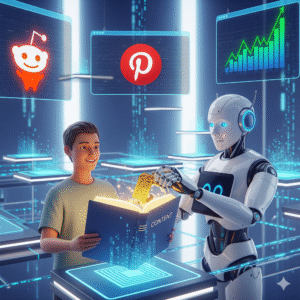
Imagine you have a small shop that sells amazing, handmade toys. Every day, you stand outside and try to find the right people to show your toys to. Some days you get lucky, but most days you’re just guessing who might be interested. It’s a lot of hard work, and you often feel like you’re talking to a brick wall. Now, what if you had a super-smart helper who could listen to thousands of conversations, understand what people want, and then whisper in your ear exactly who to talk to and what to say? This is the power of ai in digital advertising.
This isn’t science fiction; it’s a technology that helps businesses stop guessing and start knowing. It’s a special kind of assistant that uses smart computer programs to learn from patterns and make amazing predictions. It helps you find the right customers, talk to them in the right way, and get your business noticed. This article will tell the story of a toy shop owner named Maya and show you exactly how she used ai in digital advertising to turn her guessing game into a winning strategy.
The Problem: Guessing Isn’t a Strategy (ai in digital advertising)
Maya loved her toys, but her advertising was a mess. She would post pictures of her new wooden race cars on social media and hope someone would see them. She’d pay for ads on the internet, showing the same ad to everyone, whether they were a parent looking for a gift or a teenager who didn’t care about toys. She was spending a lot of money and time, but her toy sales were flat. The constant struggle to manually manage her campaigns left her frustrated, and she knew her traditional digital marketing and ai approach was failing. She needed to find a smarter way to connect with the right people.
Fortunately, Maya discovered that she could use digital marketing with ai to make her efforts more effective. Instead of guessing, she could use smart tools to find the people who were most likely to love her toys. The journey began with a simple question: “Who are my best customers?” This led her to discover the amazing capabilities of ai and machine learning in digital marketing.
AI in Digital Advertising: Knowing Your Customers Better
Maya’s first step was to use an AI tool to understand her customers better. She had a list of everyone who had ever bought a toy from her. The list included their ages, what they bought, and how they found her shop. She fed all this information to her new ai for digital marketing tool. The tool didn’t just read the list; it analyzed it deeply, finding hidden connections that Maya would never have found on her own. For example, it discovered that people who bought her puzzles were also very likely to buy her art kits. People who followed her on social media loved her behind-the-scenes videos. This is what we call AI audience segmentation, and it was a game-changer for Maya.
Using this new knowledge, Maya could split her customers into different groups. Now, when she wanted to sell more puzzles, she knew exactly which group of people to show an ad to. This simple change meant her ads were no longer being wasted on people who weren’t interested. This first step with ai and digital marketing saved her a lot of money and time, while also increasing her sales.
AI Digital Advertising: Making Your Ads Smarter
Once Maya knew who to talk to, she needed to figure out the best way to talk to them. This is where ai digital advertising came in. The AI tool could not only show the right ad to the right person, but it could also change the ad on its own to make it better. For example, the tool might test two different ads for the same race car toy: one with a picture of the car in a box, and another with a video of a child playing with it. The AI would watch which ad got more clicks and then automatically show the better-performing ad more often.
This is a key part of ai in modern digital marketing. It’s like having a team of tiny digital helpers constantly working to improve your campaigns. The AI tool was so effective that it started to suggest different headlines and even colors for the ads, all based on what it learned from people’s behavior. The constant, automatic optimization of her ads gave Maya a powerful advantage over her competitors. This is the ultimate example of ai driven digital marketing in action.
Real-World Examples: Companies Winning with AI (ai in digital advertising)
Many businesses, big and small, are already using artificial intelligence and digital marketing to achieve incredible results. Here are three examples.
Case Study 1: The Fast-Food Chain and Personalized Offers
A well-known fast-food chain uses AI driven digital marketing to make special offers just for you. When you use their app, the AI watches what you order and when you order it. If you always buy a coffee in the morning, the AI might send you a special offer for a discounted pastry to go with your coffee. The AI knows you’re a morning coffee person, so it can make a guess about what else you might want. They also use AI performance marketing to test different ad images and text to see which ones get the most people to visit their restaurants. This makes their ads much more effective and helps them sell more food.
Case Study 2: The E-commerce Giant and “People Also Bought”
Think about a huge online store like Amazon. When you look at a product, you often see a section that says, “Customers who bought this item also bought…” This is not a human making those suggestions. It’s a very advanced use of ai in digital advertising. The system looks at millions of sales and finds patterns. It learns that people who buy a toy car are very likely to also buy a toy race track. It then recommends the race track to you. This is an incredible way to sell more products by showing people things they are already interested in. This is a clear example of how ai and machine learning in digital marketing work together to predict human behavior and increase sales.
Case Study 3: The News Website and Content Recommendations
News websites often use AI for online marketing to show you the articles you’ll find most interesting. The AI looks at what you’ve read in the past and how long you spent on each article. It then compares your reading habits to others with similar interests. When you return to the site, the AI-based system will show you articles it thinks you will like. This makes you more likely to stay on the site and read more, which is a big win for the website. The same technology is used in ai for content briefs to help marketers create content that people are already searching for, making the content more likely to be successful.
Top Tools for Your Modern Digital Marketing Toolkit (ai in digital advertising)
Ready to get started? You don’t need to be a computer whiz to use these tools. Here are a few that can help you with your own ai based digital marketing efforts.
- Jasper: This is a writing robot. You can give it a simple request, like “write a short ad about my new running shoes,” and it will create different versions for you to choose from. It is perfect for ai for content creation.
- HubSpot: This tool helps you manage all your customers and your marketing in one place. Its AI features can help you figure out who to email and when to email them to get the best results. It’s an excellent way to start with ai in modern digital marketing because it simplifies complex tasks.
- SEMrush: This tool is like a detective for your website. It uses machine learning in online advertising to figure out what words people are searching for to find websites like yours. It can tell you exactly which words to use in your blog posts and ads to get more people to find you online.
- ChatGPT: This is a conversational AI that can help you brainstorm new ideas for your campaigns or write a first draft of an email. It’s an easy way to get started and see how AI can help you with your day-to-day tasks.
Your Beginner-Friendly Guide to Building an AI Marketing System
Getting started with a new technology can feel a little scary, but it doesn’t have to be. Just remember to start with one small step. Here is a simple plan to help you begin your journey with using ai in digital marketing.
Step 1: Find Your Biggest Problem
Think about the most frustrating part of your job. Is it writing emails? Or is it figuring out what to post on social media? Or maybe it’s knowing if your ads are working? Pick just one thing. For Leo, his biggest problem was knowing who his customers were. Once you know your problem, you can find a specific AI tool that solves it.
Step 2: Use One Tool to Solve One Problem
Don’t try to use all the tools at once. If your problem is writing emails, try a tool like Jasper. If your problem is knowing who your customers are, try a tool like HubSpot. This simple, focused approach is a great way to start with ai in digital marketing. The goal is to use the role of ai in digital marketing to save time and effort.
Step 3: Learn from the AI
Remember that the AI isn’t perfect. It’s a partner, not a boss. When the AI suggests a headline for an ad, read it and ask yourself, “Is this what a human would say?” You can learn a lot from the AI’s suggestions and get better at your own job. It’s a team effort. The human and the AI working together is the real magic.
The Future: Your AI Marketing Partner (ai in digital advertising)
In the end, it’s important to remember that ai in digital advertising is not here to replace you. Instead, it is here to help you. It is the smart sidekick that can do the boring, time-consuming tasks so you can focus on the truly creative and human parts of your job. The best marketers of the future will be the ones who know how to use these powerful tools to find their perfect audience, create better content, and build a more successful business.
Machine Learning in Digital Marketing
Credible References:
- HubSpot: The Role of AI in Content Creation and Marketing
- McKinsey: Generative AI’s Impact on the Marketing Landscape
Digital Marketing Using AI: Your Secret Weapon for Business Growth