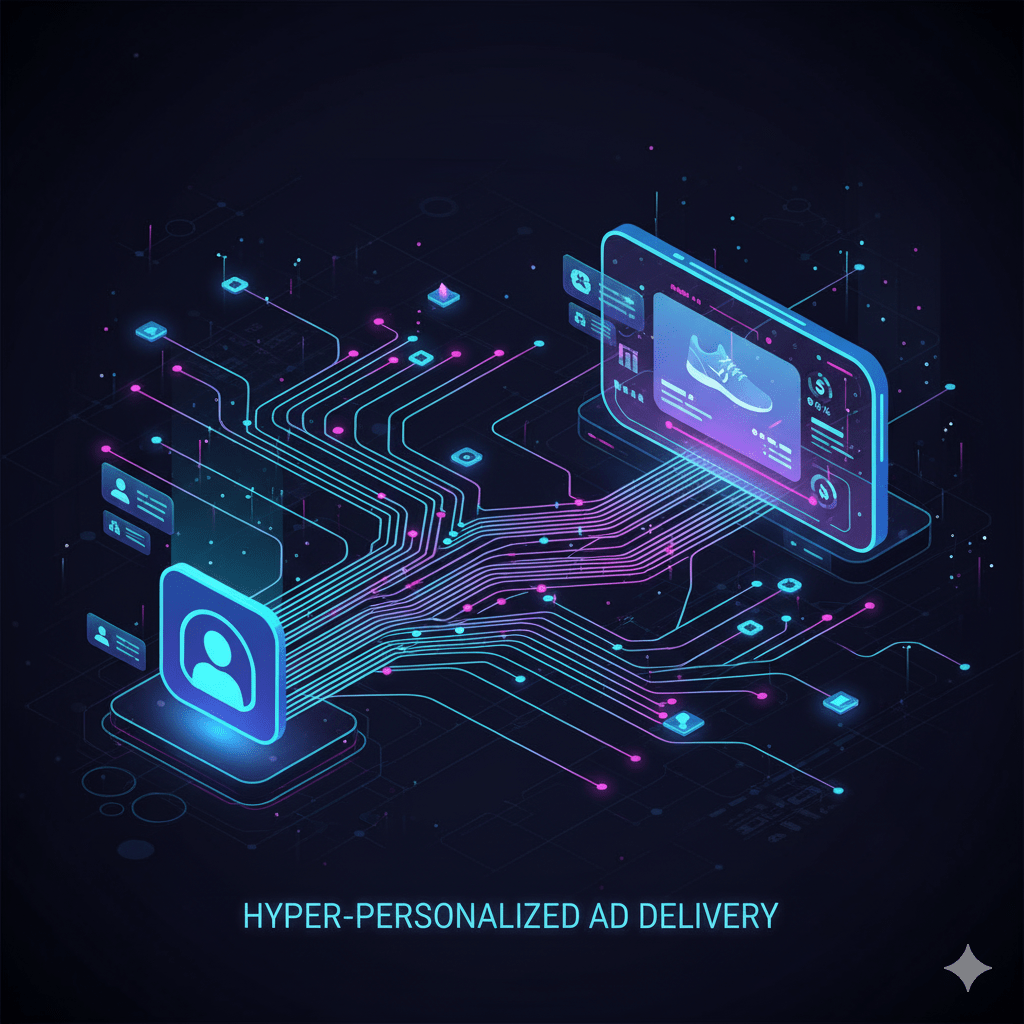
Imagine you’re running a lemonade stand. You’ve made the best lemonade in the world, but your stand is hidden on a quiet back street. You know thousands of people walk by the main road every day, but you can’t afford to shout your price at every single one of them. You need to know exactly which three people are thirsty, have a dollar, and are actually walking toward your street right now. (how does meta use ai for ads)
For years, running ads on platforms like Facebook and Instagram (which are both part of Meta) felt like guessing. Marketers were shouting at huge crowds, hoping to hit a few thirsty customers, and wasting money on everyone else. This is the exact problem that Maria faced.
Maria runs a small online store selling beautiful, hand-painted ceramic mugs. She knew her mugs were perfect for people who love quiet mornings and cozy home decor, but her ad budget was tiny. She spent hours manually choosing who to show her ads to: “Okay, maybe people who like tea? Or people who live in San Francisco?” She was guessing, and the result was usually high costs, low sales, and a lot of frustration.
Maria’s problem wasn’t her product; her problem was the Guessing Game. She needed to move from guessing to knowing, and that’s precisely what happens when you understand how does Meta use AI for ads.
The simple truth is, Meta Ads are not run by humans anymore—they are run by the most powerful, complex AI model in the world. This AI is your secret weapon. It is the ultimate Matchmaker, Calculator, and Creative Director, capable of finding those three thirsty customers out of a crowd of a million. This detailed guide will show you five powerful secrets about how does Meta use AI for ads so you can stop guessing, start winning, and achieve ai driven meta ads mastery.
Secret 1: The AI as the Perfect Matchmaker (Connecting the Dots)
The biggest question marketers used to ask was, “Who should I target?” Now, we ask, “How does Meta use AI for ads to find my customer?”
Think of Meta’s AI as the world’s best matchmaker. It has a massive digital notebook on every single person, but it doesn’t just note what people say they like (e.g., “I like cats”). It notes what people do.
The AI’s Digital Notebook (Signal Processing):
Every time you scroll past an ad, click a “like” button, watch a Reel for more than three seconds, or hover over a product photo, you are sending a tiny digital signal. The Meta AI technology gathers billions of these tiny signals every single second.
When Maria runs an ad for her ceramic mugs, she doesn’t tell the AI, “Find people who like ceramics.” Instead, the AI looks at the past behavior of everyone who has ever bought a mug from any store. The AI might discover that the perfect mug buyer is a person who:
- Watches video ads for home goods until the end.
- Clicks on “Shop Now” buttons but usually waits 48 hours before buying.
- Lives in a small apartment and frequently clicks on articles about gardening.
Maria didn’t input those rules—the AI figured them out. This process, known as deep learning and prediction, is the core of how does Meta use AI for ads to choose the right person for your product. It moves beyond simple “interests” to predict the likelihood of purchase.
Creative Workflow Automation Secrets
Case Study 1: The Mug Matchmaking Miracle
Maria used to spend $100 per day trying to reach a broad audience of 1 million people. Her results were poor. After learning how does Meta use AI for ads, she switched to Meta’s automated targeting tool, Advantage+ Audience.
- The AI Action: Maria gave the AI the simple prompt: “Find people most likely to purchase a ceramic mug.”
- The Result: The AI ignored 99% of the audience and focused her ad spend on just 10,000 highly engaged users who matched the secret “mug buyer profile.”
- Measurable Result: Maria’s Cost Per Purchase (CPP) dropped from $30 to $12. Her sales tripled without increasing her budget, thanks to the AI’s perfect matchmaking.
Apps to Make Video Ads Are the Secret
Secret 2: The Real-Time Auction Calculator (The Bidding Game)
A common question is: “When I run an ad, how does Meta decide which ad wins the spot on someone’s feed?” This is where the AI acts as a lightning-fast Calculator during the Ad Auction.
Every time a user (let’s call her Jane) opens her Instagram app, Meta runs a tiny, invisible bidding game in the background that lasts only milliseconds. Hundreds of businesses want to show their ad to Jane.
The AI does three things to pick the winner:
- The Bid: This is how much Maria said she is willing to spend. But Meta rarely just picks the highest bidder!
- The Quality Score: This is a score the AI gives your ad based on how much it thinks Jane will like it. If the AI thinks Jane is going to hate your ad and hide it, your score is low, and your ad won’t win, even if you bid high.
- The Action Prediction: This is the most important part. The AI predicts the likelihood that Jane will actually take the desired action (e.g., buy the mug). If the AI predicts a 50% chance of Jane buying, your ad’s value jumps incredibly high.
The winning spot doesn’t go to the highest bidder; it goes to the ad that provides the best value to the user (Jane) and the platform (Meta). The AI constantly runs this complex equation in real time, guaranteeing that every impression is optimized. This mechanism of predicting user behavior is crucial to understanding how does Meta use AI for ads.
Secret 3: The Creative Director (Endless Idea Generation)
One of the newest and most exciting answers to how does Meta use AI for ads is in the realm of creative content, which is often handled by an ai meta ads creator.
Before, Maria had to hire a photographer to take one perfect picture of a mug. If that picture didn’t sell, she was stuck. Now, the AI can act as a tireless Creative Director.
AI’s Creative Superpowers:
- Background Magic: Maria uploads a raw photo of her mug. The AI instantly uses Generative AI to change the background. One version might place the mug on a sunny kitchen counter; another might put it on a cozy bedside table with a book. The AI generates hundreds of scene variations until it finds the setting that makes people stop scrolling.
- Text and Tone Testing: The AI can automatically write ten different versions of the headline, testing which one performs best. It figures out if your audience responds better to “NEW MUGS 50% OFF” or “FIND YOUR COZY MORNING RITUAL.” This speed of testing, known as Dynamic Creative Optimization (DCO), is key to achieving ai driven meta ads mastery.
- Sizing and Format: The AI automatically takes the mug image and sizes it perfectly for a square Instagram photo, a tall Instagram Story, and a wide banner ad, ensuring the creative always looks amazing, regardless of where it appears. This creative optimization massively reduces the need for manual work.
Case Study 2: The E-commerce Creative Test
A mid-sized clothing brand needed to advertise a new spring collection. They manually created four ads. They ran them for a week and got lukewarm results.
- The AI Action: They adopted DCO, allowing the AI to test 30 headlines, 10 images, and 5 descriptions—creating 1,500 unique ad combinations.
- The Result: Within 48 hours, the AI found the winning combination: a picture of a model looking away from the camera, paired with a headline focused on comfort, not price.
- Measurable Result: Their Click-Through Rate (CTR) increased by 70% because the AI found the creative angle the humans never would have predicted. This ai in advertising example shows the true power of human-AI collaboration for creators.
Secret 4: Budget Optimization (The Smart Chef)
When you choose to use Meta’s Advantage+ campaigns (or “Advantage+” features), you are essentially handing over your wallet to the Smart Chef AI agent for meta ads. This AI is brilliant at budget optimization.
The Smart Chef Analogy:
When Maria tried to run ads herself, she was like a nervous chef constantly moving money around. She might decide on Monday, “I’ll spend $50 on the Instagram audience and $50 on the Facebook audience.” What if the Instagram audience runs out of thirsty customers by 2 PM? $30 is wasted.
The Smart Chef AI never makes that mistake. The AI doesn’t care about the initial labels (Facebook vs. Instagram). It only cares about results. It sees that Instagram is making sales cheaply at 10 AM, so it spends $70 there. Then, it sees that Facebook is suddenly cheap after 9 PM, so it spends the remaining $30 there. The Smart Chef is constantly tasting, adjusting, and moving the resources to where they are most effective at that exact moment.
This is the principle of AI driven meta ads mastery. The AI makes thousands of tiny adjustments per hour that no human could ever keep up with, ensuring you get the maximum value for every dollar spent.
Secret 5: Prediction Over Personalization (The Future-Teller)
The final secret about how does Meta use AI for ads is that it’s shifting away from traditional personalization and moving toward prediction.
It’s no longer about showing Jane an ad because she bought a similar mug before. It’s about showing Jane an ad because the AI predicts she is in the buying mood right now.
- The Buying Mood: The AI looks for clues: Did Jane just put her phone on silent? Did she just open a payment app? Did she just search for product reviews on Google? These are high-intent signals.
- The AI tool can detect that Jane has shown these subtle buying signals and will immediately prioritize showing her Maria’s ad before she changes her mind, even if Maria didn’t tell the system to look for those specific behaviors.
This predictive power is why modern campaigns focus less on narrow targeting and more on broad, high-quality creative. The marketers’ job is to provide the excellent raw material (the product and the creative); the AI handles the hard work of predicting when and where to present it.
Your Toolkit for AI Ads Success
To capitalize on how does Meta use AI for ads, you need to use the tools Meta provides and integrate powerful external AI tools to run Meta Ads.
- Meta Advantage+ Suite: This is Meta’s built-in AI agent for meta ads. You must use Advantage+ Shopping Campaigns and Advantage+ Audience features, as this hands control of targeting and budget optimization directly to Meta’s most powerful AI model. Meta for Business explains the full power of Advantage+ campaigns here.
- Creative Tools (e.g., Canva/Adobe Express): These tools leverage Generative AI to instantly resize images and generate multiple ad copy options (ai meta ads creator), allowing you to feed the Meta AI a constant stream of fresh ad creative.
- Third-Party AI Tools (e.g., AdCreative.ai): These specialized AI tools to run Meta Ads analyze your existing data and suggest entirely new creative ideas and audience segments based on machine learning, pushing you further toward ai driven meta ads mastery.
- Google Analytics 4 (GA4): While outside Meta, the AI inside GA4 helps you understand the quality of the customer Meta sends you, allowing you to give better feedback to the Meta AI system (by telling it what worked after the click).
The Human Role: The Architect, Not the Laborer
Maria, the mug seller, stopped trying to outsmart the AI. She realized the human role has changed:
- The Old Way (Laborer): Maria spent 80% of her time manually setting budgets, choosing interests, and resizing photos.
- The New Way (Architect): Maria spends 80% of her time focusing on the product story and providing high-quality raw materials (photos, videos, and clear messaging). She only gives the AI the final goal: “Get me a purchase for under $15.”
The AI is the machine that executes the plan, but you, the human, are the architect who designs the goal and provides the unique, beautiful creative that no machine can truly replicate. This is where true AI and creativity meet, ensuring effective and authentic advertising.
By understanding how does Meta use AI for ads—as a Matchmaker, Calculator, Creative Director, Smart Chef, and Future-Teller—you stop being a passive user of the platform and become a strategic commander of one of the world’s most powerful AI applications, securing your success in the future of digital advertising.
Credible References
- Meta for Business/AI Research: Official documentation from Meta detailing the deep integration of AI in their auction system, specifically addressing prediction modeling, value optimization, and the shift toward automated features like Advantage+ to ensure advertisers maximize ROI. Read Meta’s perspective on maximizing ad value.
- McKinsey & Company: Analysis and insights into the global shift toward autonomous marketing systems, highlighting the measurable financial benefits of integrating AI agents and predictive models for massive scale and efficiency in media buying. View McKinsey’s Generative AI in Marketing Report.