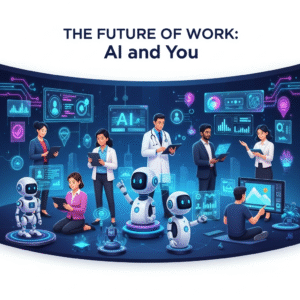
Imagine logging out of your computer on a Friday, feeling utterly defeated by a mountain of endless data entry and repetitive email responses. You return on Monday, and a new software update has quietly automated 70% of that exact workload. This is not a futuristic sci-fi movie scenario. Rather, it is the immediate, daily reality facing millions of professionals right now. We are currently watching a fundamental, permanent restructuring of corporate office life. Naturally, the full-time workers ai impact triggers both incredible excitement and deep, quiet anxiety. Will your specific role still exist in three years? How exactly are massive tech giants like Google shifting the landscape beneath our feet?
By the end of this comprehensive guide, you will understand exactly how artificial intelligence is reshaping 9-to-5 employment from the ground up. Furthermore, you will learn how to strategically position yourself as an indispensable human asset rather than a replaceable corporate metric.
Understanding the Artificial Intelligence Workplace Impact
To truly grasp what is happening, we need to completely reframe how we view this technology. Think of AI not as a cold, robotic replacement, but as an incredibly fast, highly literal, yet somewhat naive intern. If you give this intern vague, lazy instructions, you will get a chaotic mess in return. However, if you guide them with perfect clarity, they will save you forty hours a week. Understanding this dynamic is the first step to mastering the artificial intelligence workplace impact.
Why is this massive shift happening right now? The sudden acceleration of large language models, particularly Google AI and its major competitors, has made complex natural language processing accessible to everyday users. Consequently, global businesses are rushing to integrate these systems to slash operational costs and drastically boost baseline efficiency. The full-time workers ai impact is, at its core, a story about human leverage.
Previously, a senior marketing manager could meticulously write two major campaigns a week. Now, armed with intelligent generative AI tools, that same manager might oversee ten. The job itself does not instantly vanish; instead, it transforms from manual creation to high-level curation. Therefore, understanding and embracing this technological shift is the absolute most critical step toward securing your long-term career trajectory. Up next, we will examine the exact mechanics of this workplace disruption.
Deeper Dive: Navigating the AI Impact on Jobs
The mechanics of this digital transition go far beyond simple customer service chatbots. We are currently witnessing a systemic evolution in exactly how daily tasks are executed, measured, and ultimately valued by employers. To truly grasp the full-time workers ai impact, we must break down the specific areas where machine learning is taking root. Here is how the modern office landscape is fundamentally changing:
- Total Routine Automation: Repetitive administrative chores, such as calendar scheduling, basic invoice sorting, and introductory email outreach, are being entirely handed over to AI assistants.
- Enhanced Decision Making: Advanced algorithms can now analyze five years of dense company data in mere seconds. As a result, executives and managers make significantly faster, more informed choices without waiting weeks for manual reporting.
- Creative Augmentation: Professional writers, graphic designers, and software coders are aggressively using generative tools to overcome blank-page syndrome. For instance, Google Gemini in workplace environments often drafts the initial project outline, leaving the human expert to refine the nuanced details.
- Corporate Skill Democratization: Junior-level employees can now produce senior-level output by leveraging AI-driven strategic insights. Consequently, this dramatically flattens the traditional corporate hierarchy and changes how promotions are awarded.
How does AI affect full-time employment daily?
AI affects full-time employment by aggressively shifting human labor away from raw execution and pushing it toward overarching strategy. Instead of spending six hours compiling a dense spreadsheet, a worker now spends ten minutes prompting an AI to generate the report. Following that, they spend an hour analyzing what those numbers actually mean for the company’s bottom line. Ultimately, artificial intelligence acts as a massive productivity multiplier. It actively forces employees to upgrade their soft skills—such as critical thinking, empathy, and complex problem-solving—because the hard, repetitive skills are increasingly commoditized and automated.
The Future of Full-Time Work in Real-World Scenarios
Let’s ground this heavy theory in absolute reality. How are actual, operating companies handling the full-time workers ai impact right now? Consider a mid-sized digital marketing agency based in Chicago. Two years ago, their copywriting team consisted of five full-time employees grinding out daily blog posts. Recently, leadership integrated advanced AI tools directly into their workflow.
Surprisingly, they did not fire anyone. Instead, those five writers officially became “content directors.” Specifically, they now use AI to generate rough drafts, allowing them to focus heavily on brand voice, competitive SEO strategy, and high-level client relations. Their output tripled, and agency revenue soared.
In stark contrast, consider a global logistics firm’s customer service department. They implemented a highly sophisticated AI chatbot to handle all level-one tracking queries. Consequently, the need for entry-level, full-time support agents dropped dramatically. According to a recent global workplace study published by the World Economic Forum, automation will indeed disrupt millions of routine roles while simultaneously creating new, tech-centric ones. The remaining logistics workers were rapidly upskilled to handle complex, emotionally charged customer escalations. These examples highlight a critical truth: the impact is rarely a complete job wipeout. Rather, it is an aggressive reallocation of human energy and capital.
Actionable Steps: Preparing for How Google AI Changes Office Work
You cannot stop the technological tide, but you can certainly learn to surf it. Adapting to the full-time workers ai impact requires a fiercely proactive approach. Passively waiting for your employer to train you is a dangerous career gamble. Therefore, you must take total control of your own upskilling journey today. Here is a clear, step-by-step workflow to future-proof your career.
First, strictly audit your current daily tasks. Spend one entire week writing down absolutely everything you do, minute by minute. Next, review that list and identify the highly repetitive, predictable elements of your workload. Then, dedicate an afternoon to researching which specific AI tools can automate those exact chores.
After that, commit to integrating just one new AI tool into your workflow each month. Do not overwhelm yourself by trying to learn everything at once. Finally, take the physical time you saved and intentionally redirect it toward high-level strategy, relationship building, or cross-departmental collaboration. By actively doing this, you instantly elevate your value from a “doer” to a “thinker.”
Best AI tools for full-time employees
The best AI tools for full-time employees depend entirely on your specific industry, but a few universal platforms stand out immediately. First, mastering the prompts for Google Workspace’s integrated AI is essential for email management and rapid document drafting. Second, Anthropic’s Claude is phenomenally gifted at analyzing massive, complex PDF reports and generating nuanced, highly accurate summaries. Lastly, database tools like Notion AI are absolutely perfect for modern project management and organizing messy, unstructured meeting notes. Mastering just one of these platforms will give you a massive, undeniable productivity advantage over hesitant colleagues.
Essential Resources for Generative AI Productivity
Building your own personal, curated tech stack is crucial for surviving and thriving amidst the full-time workers ai impact. Here are four indispensable, industry-leading resources that are actively reshaping the modern office right now:
- Google Gemini Advanced: This is Google’s flagship, heavyweight AI model. It is deeply integrated into their broader ecosystem and is absolutely ideal for deep research, coding assistance, and generating strategic business plans directly within Docs or Sheets.
- ChatGPT (Plus/Team): Developed by OpenAI, this platform remains the gold standard for conversational AI. It is exceptionally excellent for rapid brainstorming, drafting sensitive communications, and building custom, private GPTs tailored to your specific daily workflows.
- GrammarlyGO: Moving far beyond simple spellcheck, this contextual tool understands intent and tone. It actively helps busy professionals rewrite emails or reports to sound more assertive, diplomatic, or concise as needed.
- Zapier: While not a traditional generative AI itself, Zapier seamlessly connects thousands of disparate apps. Furthermore, it now incorporates advanced AI logic to automate complex, multi-step workflows between your email inbox, CRM platform, and task management software without writing a single line of code.
Common Myths About AI Replacing Full-Time Roles
Fear almost always breeds viral misinformation. When aggressively discussing the full-time workers ai impact, several stubborn, pervasive myths heavily cloud the actual conversation. Let’s decisively dismantle these misconceptions so you can navigate your career path with total clarity.
Myth: AI will entirely replace all white-collar jobs within the next five years. Reality: While AI will certainly automate specific tasks, it very rarely automates entire, holistic jobs. For example, a corporate lawyer effectively uses AI for rapid case research, but an AI cannot passionately argue in front of a human judge or negotiate a delicate settlement with emotional nuance.
Myth: Only hardcore software engineers and tech workers need to learn artificial intelligence. Reality: The exact opposite is actually true. Public school teachers, HR professionals, and traditional financial analysts are currently seeing the absolute biggest productivity gains. Consequently, treating AI simply as “an IT department thing” will leave you severely disadvantaged in the broader job market.
Myth: The output generated by AI is always factually perfect and unbiased. Reality: AI models frequently “hallucinate” false information and can echo the biases present in their training data. Therefore, human oversight, critical fact-checking, and ethical judgment remain incredibly vital. As a Harvard Business Review analysis recently noted, the human-in-the-loop model is currently the only safe way to deploy AI in high-stakes corporate environments.
pubg january 2026 update: The Future of Battle Royale is Here
FAQ — Full-Time Workers AI Impact Questions Answered
What is the full-time workers ai impact right now?
Currently, the immediate impact heavily centers on task augmentation rather than full replacement. Full-time workers are utilizing AI to handle dense data processing, initial document drafting, and complex scheduling. This specifically allows them to focus intensely on complex problem-solving and human relationship management, effectively increasing their individual daily output.
Will generative AI replace my full-time job?
It is highly unlikely that AI will completely replace your entire job description anytime soon. However, a person who aggressively knows how to use generative AI efficiently will very likely replace someone who stubbornly refuses to learn it. Constant adaptation is your absolute best defense against corporate obsolescence.
How is Google AI changing the standard 9-to-5 workday?
Google AI, particularly through its deep Workspace integrations, is drastically reducing the sheer time spent on mundane email triage, presentation design, and raw data analysis. Therefore, the standard workday is becoming significantly less about the administrative grind and much more about strategic, high-level decision-making.
What are the safest career paths from AI disruption?
Careers requiring exceptionally high emotional intelligence, complex physical dexterity, or unpredictable strategic negotiations remain the absolute safest. Specific roles like specialized therapists, trauma surgeons, senior HR directors, and high-level enterprise sales professionals are incredibly difficult to replicate with current algorithms.
Conclusion
Navigating the complex realities of the full-time workers ai impact absolutely does not require an advanced computer science degree. Instead, it strictly requires a resilient willingness to adapt, experiment, and courageously embrace change. Artificial intelligence is rapidly stripping away the mundane, robotic tasks that most of us never genuinely wanted to do anyway. Consequently, it is heavily forcing us to double down on exactly what makes us uniquely human: deep empathy, wild creativity, and bold strategic vision.
Therefore, do not view Google AI or other major platforms as your incoming replacements. Treat them proudly as your relentless, brilliant digital interns. The future undoubtedly belongs to the professionals who learn to manage and direct these tools effectively. I strongly encourage you to open one AI platform today, feed it a highly frustrating task, and watch your daily productivity permanently transform.
pubg global championship 2025: The Battle for the Golden Pan