Think about the last time you bought something online. Maybe you saw an ad for a new pair of shoes. You clicked on it, looked at a few pictures, and then decided to buy them. The path you took, from first seeing the ad to hitting the “buy” button, is called the customer journey. For a long time, marketers would try to guess what customers wanted at each step. This was a lot of hard work. But now, a new kind of technology is changing everything. AI for customer journey mapping is like giving marketers a super-smart map. It helps them see every step a customer takes. It also helps them create a journey that is perfect for each person.
AI is not here to replace marketers. Instead, it is here to make them a lot smarter and faster. It handles all the tedious, data-heavy work. This frees up people to focus on what they do best: building relationships and coming up with great ideas. This article is your guide to using AI to drive more revenue. We’ll break down what AI is, how it helps at every stage of the customer journey, and show you some real-world examples. By the end, you’ll understand why a strong grasp of AI is the most important skill for any business in 2025 and beyond.
Mapping the Journey with AI: Your Smart Marketing Map
A customer journey is a series of steps a person takes when they interact with a business. It starts when they first hear about you. It ends when they become a loyal customer. In the past, marketers would draw a simple map to understand this journey. They would try to guess what a customer was thinking at each step. But this map was often incomplete. It was missing a lot of important details.
Today, AI for customer journey mapping is making this map much smarter. AI can look at a lot of different information. It can look at how a person interacts with your website, what they click on, and what they buy. It then uses this information to create a very detailed map of their journey. This helps a marketer see exactly what a person is doing and what they need next.
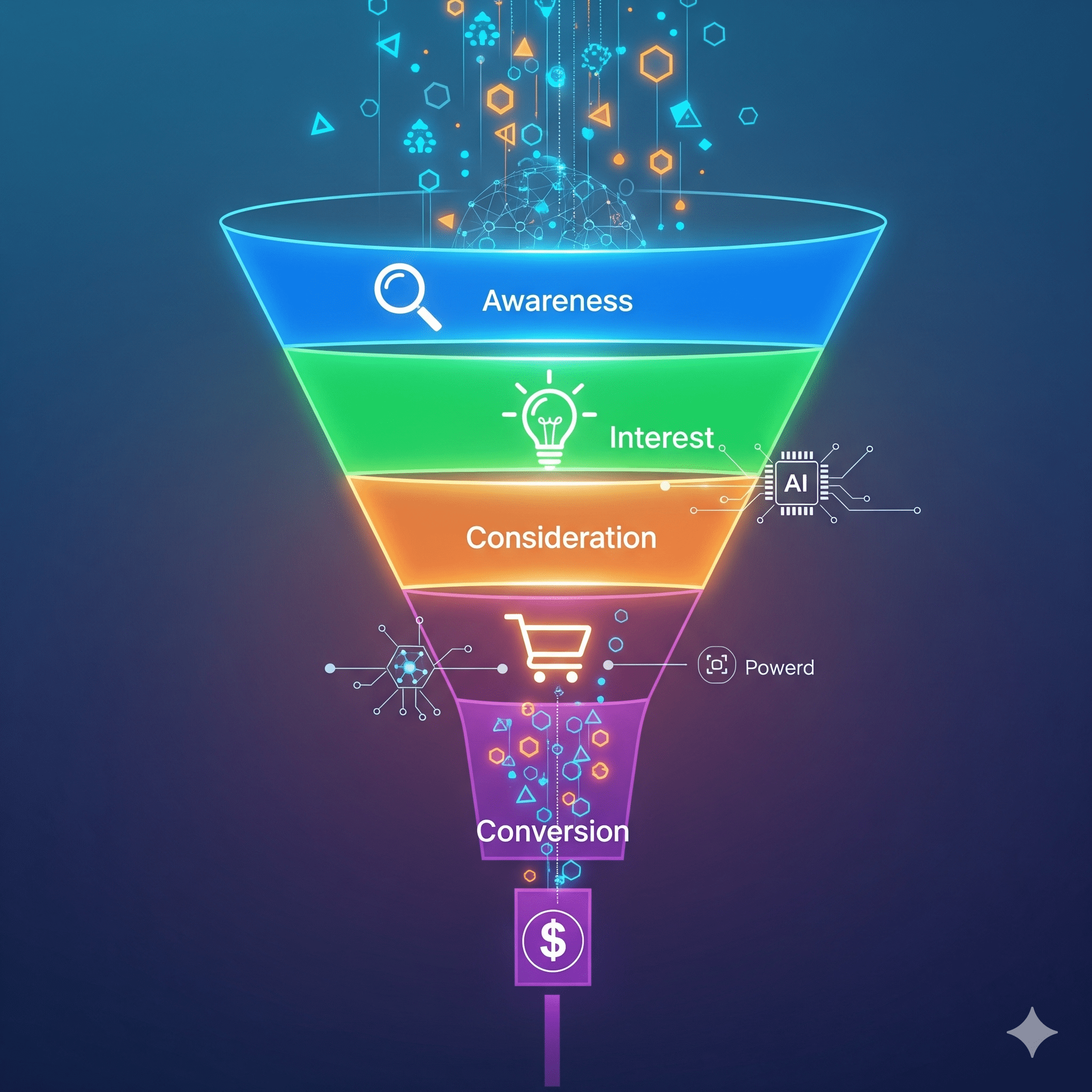
Here is how AI helps with each stage of the journey: (AI for customer journey mapping)
- Awareness: This is the top of the funnel. It’s when a person first hears about you. AI helps you find the right people for your ads. It looks at what people are searching for online. It can then show an ad to a person who is likely to be interested. This is a much smarter way to advertise. It helps you save money and get better results.
- Consideration: This is the middle of the funnel. It’s when a person is learning about your product. AI helps you send personalized content to each person. For example, a person who reads a blog post about one of your products might receive an email with more information about that product. This helps them feel like you understand their needs.
- Purchase: This is the bottom of the funnel. It’s when a person decides to become a customer. AI helps you make this process as easy as possible. It can predict what a person will buy next. It can then show them a product they are likely to be interested in. This helps you win more deals.
- Loyalty: This is the stage after a person buys from you. Your goal here is to keep them happy and to make them a loyal customer. AI can send a personalized email to a customer with a special offer. It can also suggest new products they might like. This helps you build a strong relationship with your customers.
This is just one of the many AI marketing strategies that are changing the industry. AI helps you make every step of the journey count.
AI for Personalization: A One-on-One Conversation
Think about walking into a store. The store clerk greets you and knows your name. They also remember what you bought last time. This makes you feel special. It makes you feel like the store cares about you. Now, imagine a website that does the same thing. This is called AI for personalization. It is the secret to a great customer experience. AI helps you treat every customer like a person, not a number.
How does AI do this? It looks at a lot of different data. It can look at what a person has clicked on. Also, It can also look at what they have bought. It then uses this information to create a personalized experience.
Here are some of the ways AI helps with personalization:
- Personalized Recommendations: AI can look at a person’s past purchases and suggest a product that they are likely to buy next. This is what Amazon does. This is a very effective way to increase sales.
- Personalized Emails: You can send a personalized email to a customer with a special offer. It can also suggest new products they might like. This makes the customer feel special.
- Dynamic Content: AI can change the content on a website based on who is looking at it. For example, a person who lives in a cold city might see an ad for a winter coat. A person who lives in a hot city might see an ad for a summer dress. This makes the content much more relevant to each person.
This is a very powerful way to grow your business. According to a McKinsey report, companies that do personalization well generate 40% more revenue from it than their competitors. This shows that AI for personalization is not just a nice-to-have. It is a must-have.
AI Customer Insights: Your Business Mind-Reader (AI for customer journey mapping)
A lot of companies want to know what their customers are thinking. They want to know what they like. They want to know what they do not like. In the past, they would have to send out surveys. This was a slow process. It was also hard to get a lot of information. But now, AI customer insights is making this process a lot easier. It is like having a business mind-reader.
How does AI help with customer insights? An AI can look at a lot of different information. It can read customer reviews, social media posts, and support tickets. It can then figure out what people are feeling about your product. This is called sentiment analysis. It helps you find out what people like about your product and what they don’t.
Here are some ways AI helps with customer insights:
- Product Improvement: The AI can read customer feedback. It can then tell you what features people want. This helps you build a better product.
- Customer Service: The AI can analyze customer support tickets. It can then tell you what questions people are asking most often. This helps you improve your customer service.
- Marketing Strategies: The AI can look at social media trends. It can then tell you what topics people are interested in. This helps you create content that is relevant and engaging.
Ultimately, these insights help you make smarter business decisions. This is a very powerful use of AI for customer insights.
Real-World Applications of AI for Personalization (AI for customer journey mapping)
Many of the world’s most successful companies are using AI to get ahead. These real-world examples prove that AI for customer journey mapping is not just a theory; it’s a powerful tool.
Case Study 1: Netflix’s Recommendation Engine Netflix is a master of personalization. Their AI recommendation engine is a big reason why. It looks at what you watch, what you search for, and what you rate. It then uses all of that information to suggest new shows and movies. The AI is so smart that it drives up to 80% of the content streamed on the platform. This is a great example of AI for personalization in action.
Case Study 2: Starbucks’ Predictive Ordering Starbucks uses an AI engine called Deep Brew. This engine helps them create a personalized experience for every customer. It looks at your past purchases. It also looks at the weather, the time of day, and your location. If it is a cold day, the app might suggest a hot coffee. If it is a hot day, it might suggest a cold drink. It can also offer you a special deal on your favorite drink. This makes the customer feel special. It also increases sales.
Case Study 3: Sephora’s AI Chatbot Sephora, a beauty retailer, uses a chatbot on its website. The chatbot is like a personal beauty advisor. It can ask you about your skin type and your favorite colors. It can then suggest the perfect products for you. This helps a person feel like they are getting personal help. It also helps the company sell more products. The chatbot can also answer questions 24/7. This is a great example of using AI marketing strategies to improve the customer experience.
Top Tools for Your Personalized Marketing Toolkit
The market is full of fantastic tools that can supercharge your marketing. Here are a few to get you started. (AI for customer journey mapping)
- HubSpot: This is a very popular marketing platform with a lot of AI features. Its AI, called “Breeze,” can help you with your content strategy. It can also help you write emails and create social media posts. This is a great tool for any marketer.
- Crayon: This tool uses AI to help you with your competitive analysis. It can tell you what your competitors are doing. It can also tell you what they are doing well. This helps you get an edge in the market.
- Chatspot: This is a conversational CRM that connects to HubSpot. It allows marketing pros to send follow-up emails and create contacts via chat. It is a great tool for personalizing your customer interactions.
- TheyDo: This tool is designed to help you create and manage a customer journey map. You can use it to create a visual of how customers move from one stage to the next with your business. It is a great tool for any marketer who wants to understand their customers better. See source.
These tools are at the forefront of the AI marketing strategies space. They can help you take your sales and marketing to the next level.
Conclusion: The Future of Marketing is Personal
The future of marketing is not about AI replacing people. It is about a partnership between humans and AI. The AI handles the mundane tasks. The human handles the creative, emotional, and strategic parts of the job. This is the new reality of the marketing world.
A McKinsey report states that AI is a tool that helps people be more productive. It is not a replacement for human creativity. See source. The most successful companies will be the ones that redesign their workflows to include AI. By embracing this technology, you can be more productive, more creative, and more valuable. This will help you get ahead in the market and drive more revenue for your business.
AI for Personal Branding: How to Build Your Brand in the AI Age
AI Adoption Challenges Marketing: How to Turn Fear into Action