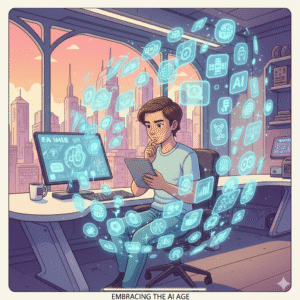
Once upon a time, there was a designer named Alex. He was very creative. He loved his job. But some days, his work felt more like a chore than a passion. He would sit in front of a blank screen, waiting for a brilliant idea to pop into his head. That blank screen felt intimidating. Therefore, his best ideas took a long time to show up. And once an idea finally arrived, he spent hours on the tedious parts of the job. For example, he would manually resize images, edit backgrounds, and create dozens of small variations for a client. His creativity was high, but his time was low. He felt like he was running in a race. But he was running against a clock that was always winning. (AI image generators for designers)
Today, however, Alex has a new partner. It’s a powerful new technology that helps him with his work. It’s called AI. The AI image generators for designers have completely changed his workflow. They have become his creative sidekick. They handle all the boring tasks. This frees him up to focus on what he does best: creating, imagining, and solving big problems for his clients. In fact, he now sees AI not as a replacement for his job. He sees it as a powerful tool. In this article, you will also discover how to use AI to make your work easier and more fun. We’ll explore how these tools work. We will also look at the top tools you should be using. By the end, you will be ready to transform your design workflow, just like Alex.
AI Art Tools: Beating Creative Block with a Single Prompt (AI image generators for designers)
Every designer has faced the “blank page problem.” It’s that moment when you need a great idea, but nothing comes to mind. This is often called creative block. It can be frustrating, and it can slow you down. Alex, for instance, used to spend hours trying to come up with new ideas for a logo. He would sketch, search for inspiration, and stare at his screen, hoping for a breakthrough. But now, he uses AI art tools to help him. They act like a brainstorming partner that never gets tired.
How does this work? Alex can give an AI a simple prompt. For example, he might say, I need a logo idea for a coffee shop that sells coffee made from beans grown in space. Make it retro and colorful. The AI will instantly give him hundreds of ideas. It can suggest different color palettes, font pairings, and even full concepts. Then he can pick the best ideas and make them his own. This process helps Alex:
- Get started faster: He doesn’t have to wait for inspiration to strike. He gets a great starting point instantly.
- Explore more ideas: He can explore many more ideas in a short amount of time than he ever could on his own.
- Think in new ways: The AI might give him an idea that a human might never think of. As a result, this can lead to very unique designs.
AI can also be used to generate visuals for a mood board. A mood board is a collection of images that gives a project a certain feel. Alex can ask the AI to generate a mood board for a “futuristic space adventure” or a “cozy coffee shop.” In a few seconds, he will have a collection of images that he can use to get a feel for the project. In this way, AI helps him spend less time brainstorming and more time creating.
AI Text-to-Image: Your Magic Paintbrush
For a long time, if you wanted to create an image, you had to draw it yourself or hire a photographer. But with AI text-to-image tools, that is all changing. It is like having a magic paintbrush. You just tell it what to draw, and it creates a masterpiece for you. This is a very powerful change for designers. It allows them to create visuals that they might not have the skills to create on their own.
Here is how AI text-to-image tools help a designer like Alex:
- Create Unique Images: Alex can give an AI a simple text prompt, and it will create a unique image for him. For example, he could type,
a fluffy orange cat wearing a blue shirt, in the style of a cartoon, sitting on a skateboard.The AI will then create an image of exactly that. This is a great way to create visuals for a blog post or a social media post without having to find a stock photo. - Image Editing: AI can also help with editing. Alex can remove the background from a photo with a single click. He can also remove unwanted objects from a photo. The AI can even make a low-quality photo look a lot better.
- Design Variations: An AI can create a lot of different versions of a design for him. For example, it can create a few different versions of a logo. He can then pick the best one and make it his own. This is a great way to save time and explore more ideas.
The possibilities with these tools are endless. You can create images in any style, from a realistic photo to a cartoon. You can also create images for any project, from a website to a t-shirt. It is a very powerful way to create new things.
AI for Graphic Design: Real-World Applications
The best way to understand how powerful AI is, is to look at real companies that are using it right now. These examples prove that AI for graphic design is not just a theory; it’s a powerful tool.
Case Study 1: Adobe Sensei and the Creative Cloud Adobe, a company that makes popular design software like Photoshop and Illustrator, has been at the forefront of this change. They built an AI tool called Adobe Sensei. It is not a separate app. Instead, it is a tool that is built into the Adobe products. Adobe Sensei can automatically tag photos with keywords. It can also help you resize images. It has a tool called “Generative Fill” that can remove unwanted objects from a photo. This has helped designers get their work done much faster and more efficiently.
Case Study 2: Spotify’s AI-Driven UX Testing Spotify, the music streaming service, has a huge user base. They need to make sure their app is easy to use for everyone. They use AI for UX testing. The AI can run many tests at once. It also finds small design flaws that a human might miss. This has helped them fix problems faster. It has also allowed them to release new features more often. This is a great example of how AI can improve a company’s product development.
Case Study 3: The Fashion Company’s Trend Forecast A fashion company used AI to predict what clothes would be popular next season. They used an AI to analyze social media trends and customer data. The AI was able to find patterns that a human would have missed. This helped the company design clothes that people actually wanted to buy. It also helped them reduce waste. This is because they knew what to make and how much to make. The designers still had the final say, but the AI gave them a huge advantage. This is a great example of how generative AI in design can lead to better business results. (AI image generators for designers)
Pitfalls of AI in Marketing: What You Must Watch Out For
Top AI Generators for Designers in 2025 (AI image generators for designers)
The market is full of fantastic tools that can supercharge your design career. Here are a few that are highly recommended.
- Canva Magic Studio: This is a great all-in-one tool for visuals. It has a lot of AI-powered features, including an image generator, a background remover, and a tool that can help you with text. It is a great tool for anyone who needs to create visual content.
- Midjourney: This is a very popular AI design tools platform for creating stunning and artistic images from text prompts. It is great for brainstorming and for getting new ideas. It is also a very powerful tool for artists and designers.
- Adobe Firefly: This tool is part of the Adobe Creative Cloud. It is great for creating images from text. It is also good for adding or removing objects from an image. It is designed to be safe for commercial use. See source.
- Uizard: This tool is designed to help you create websites and apps. It can take a sketch of a website and turn it into a full design. You can also use it to create a prototype. This tool is a great way to save time on early-stage design work.
These tools are at the forefront of the AI image generators for designers space. They can help you take your designs to the next level.
AI for Sales and Marketing: The Secret to Driving Revenue
Conclusion: The Future of Design is Human-Powered
So, is AI going to replace designers? The answer is no. Instead, AI is changing the job for the better. It is taking away the boring, repetitive work. This frees up designers to be more creative and strategic. The future of design is a partnership between human creativity and AI efficiency. The AI can handle the mundane tasks. The human can handle the creative, emotional, and strategic parts of the job.
According to a report from McKinsey & Company, the most successful companies are the ones that redesign their workflows to include AI. This is a huge change. But it is not about replacing the human. It is about empowering the human. The designers who learn to use AI as a partner will be the ones who stand out. They will be more productive. They will also be more creative. Also, They will be able to create more great designs and have a more enjoyable workflow.