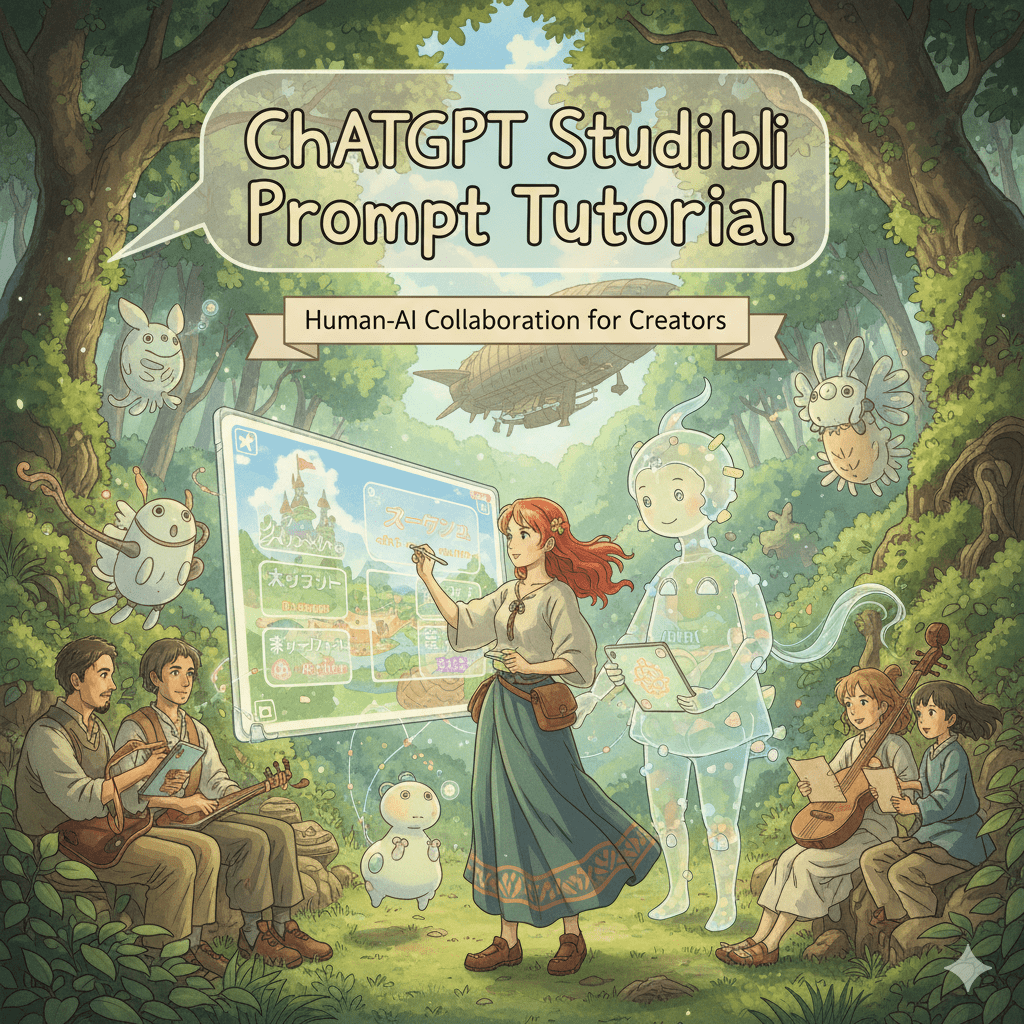
Imagine having a magic key that could unlock a treasure chest full of the world’s most beautiful, dream-like drawings, all made just for you. This key exists, and it’s called the ChatGPT Studio Ghibli prompt.
Our story starts with Leo, a young artist who loves to draw. Leo dreamed of creating worlds as beautiful and detailed as the famous Japanese films from Studio Ghibli—movies like Spirited Away or My Neighbor Totoro. But drawing those vast, emotional, perfect scenes took months, sometimes years, and sometimes, Leo just got stuck. He’d stare at a blank page, feeling frustrated because his hands couldn’t keep up with the amazing pictures in his mind.
This is a problem many creators face: they have a brilliant idea, but the hard, slow work of drawing it out takes all the fun and energy away. This is where the magic of human-AI collaboration for creators steps in. Leo discovered that he didn’t need to do all the heavy lifting. He could partner with a smart robot helper—an AI—to quickly sketch out his wildest Studio Ghibli-inspired dreams.
But how do you talk to a robot about feelings and beautiful art? You use a chatgpt studio ghibli prompt. This post is your comprehensive, easy-to-understand guide to learning the secret language that makes AI draw like a Ghibli master. We’re going to show you the exact ingredients Leo used to go from creative block to building entire fantasy worlds in minutes. By the time you finish, you’ll understand how to use this powerful tool not just to copy Ghibli, but to make your own brand of magic.
The Magic Recipe: What is a ChatGPT Studio Ghibli Prompt and Why Does It Work?
First, let’s break down the words in the secret key so everyone understands the deep magic at work here.
1. What is a “Prompt”? (It’s a Wish to a Genie)
Think of a computer program like ChatGPT or Gemini as a very smart, very fast student. This student has read almost every book, seen every movie, and looked at nearly every picture ever put on the internet.
A prompt is simply the instruction you give this student. When you ask the AI to draw something, that instruction is the prompt.
- Simple Wish (Bad Prompt): “Draw a castle.” (The AI will draw a boring, generic castle.)
- Detailed Wish (Good Prompt): “Draw a tall, mossy castle with a pink roof, sitting on a floating island, surrounded by fluffy white clouds.” (The AI will draw exactly that detailed scene.)
The better and more detailed your prompt—your wish—is, the better the final result will be.
2. What is “Studio Ghibli”? (It’s a Feeling, Not Just a Drawing)
When we talk about the Studio Ghibli style, we aren’t just talking about cartoon drawings. We’re talking about a special feeling. The films, mostly directed by the master Hayao Miyazaki, are famous for a few key ingredients:
- Wonderful Worlds: Trees, rivers, and cities are drawn with incredible detail and a soft, kind glow. Even the houses feel warm and cozy.
- Kind Characters: The main characters (often young girls) are brave, curious, and kind to animals and spirits.
- Nature & Magic: The movies mix the real world (like a rainy day) with the imaginary world (like a friendly spirit or a flying castle) in a beautiful, natural way.
The goal of a chatgpt studio ghibli prompt is to translate this feeling—this mix of detail, emotion, and magic—into a language the AI robot can understand. We are telling the AI: “Draw this thing, but make it feel like Ghibli.”
3. Deep Dive into the AI Engine (A Robot’s Brain)
Why can AI even do this? It’s thanks to something called Deep Learning and Generative AI.
Imagine the AI’s brain is a giant digital warehouse filled with billions of pictures. Every time it sees a picture labeled “Studio Ghibli,” it learns what makes that picture special: the soft color palette, the hand-drawn lines, the slightly exaggerated trees, the way the light hits the grass.
When you use the chatgpt studio ghibli prompt, the AI goes to its warehouse, pulls out all those Ghibli-style pieces, and puts them together like a perfect digital puzzle to create a brand-new image that has that unmistakable, emotional Ghibli look. This rapid construction of ideas is part of creative workflow automation.
Leo’s First Quest: Mastering the 5 Essential Ingredients of the ChatGPT Studio Ghibli Prompt
Leo realized that simply typing “Draw a Ghibli picture” was not enough. The key was to make the AI feel like it was reading a script for a new Miyazaki movie. He broke his prompts into five essential ingredients. By using these ingredients, you shift the creation process into high gear, proving the power of human-AI collaboration for creators.
Ingredient 1: The Character (Who and What They Are Doing)
Start with a clear, active subject. This is the main point of the picture. The simple language rule here is: Be a director, not a whisperer.
- Bad Example: “Girl with umbrella.”
- Good Example: “A young, curious girl with bright red rain boots, holding a yellow umbrella and staring intently at a giant, moss-covered talking cat.”
- Ghibli Touch: Add an emotion or a quiet action. Ghibli characters are often contemplating, running with joy, or eating a delicious meal.
Ingredient 2: The World and Setting (Where and When)
Ghibli worlds are just as important as the characters. They are always full of life, even if they are broken or old.
- Specific Setting: Don’t just say “a forest.” Say, “A deep, ancient forest in the rain, where the trees are so tall they almost touch the sky.”
- Light/Atmosphere (Crucial): Ghibli often uses special lighting. Use words like: “Cinematic lighting, golden hour sun, overcast mist, shafts of light filtering through the trees, soft volumetric lighting.” This is the secret sauce that gives the image its dreamy look.
Ingredient 3: The Emotion and Detail (How it Feels)
This is the most “human” part of the prompt. You are telling the AI what the feeling of the scene should be.
- Emotional Words: Use words like “whimsical, nostalgic, serene, melancholy, overgrown with nature.”
- Micro-Details: Add small touches that bring the world to life. “A steaming cup of tea resting on a wooden table,” or “Small, brightly colored flowers growing out of a rusty bicycle.”
Ingredient 4: The Technique (Like a Camera Shot)
Leo learned that AI responds to camera terms because it understands how real movies and photos are made.
- Lenses: Specify the look. “Wide-angle shot (shows more of the big world), Close-up, or Full-Body Shot.”
- Drawing Style Tags: This is the direct instruction for the AI to copy the Ghibli master’s hand. Use terms like: “Miyazaki style, Studio Ghibli art, hand-drawn animation, traditional cel-animation, high detail.”
Ingredient 5: The Style Tag (The Secret Handshake)
Finally, to guarantee the look, you need the ultimate style tag. This is the chatgpt studio ghibli prompt part that locks in the desired aesthetic.
- Always end your core instruction with:
trending on ArtStation, by Hayao Miyazaki and Isao Takahata, 4k, hyper-detailed, beautiful, Ghibli style.
The Full Master Prompt (A Template):
A determined young boy wearing a patched-up pilot’s goggles, standing on the roof of a giant clock tower overlooking a bustling, steampunk city at dusk. The mood is nostalgic and adventurous. Soft volumetric lighting from the setting sun hits the rooftops, casting long shadows. Full body shot, highly detailed, by Hayao Miyazaki, Studio Ghibli art, 4k.
The Power of Human-AI Collaboration for Creators
Leo’s friends, seeing his amazing new artwork, asked if the AI was going to take over drawing forever. Leo explained a very important truth: AI is a partner, not a replacement. This is the essence of human-AI collaboration for creators.
- The Human (You): You provide the soul. You decide the emotion, the story, the character’s goal, and the meaning behind the picture. You have the original idea.
- The AI (The Robot Helper): It provides the speed and the technical skill. It can draw 100 versions of a tree in the time it takes you to draw one leaf. It automates the long, boring parts.
By using the chatgpt studio ghibli prompt structure, you are not cheating; you are using the AI to make your original idea visible, faster. This shifts your time from tedious drawing to powerful storytelling and idea generation.
Beyond the Basics: Advanced Prompt Techniques for Next-Level Ghibli Art
As Leo got better, he started using more sophisticated tools—little tweaks that dramatically improved his chatgpt studio ghibli prompt results. This is where AI and creativity truly blend.
The “Camera Trick” (Cinematic Language)
To make an image feel like a frame from a movie, use specific cinematic terms. This is a common form of creative workflow automation used by professional artists.
- Depth of Field (DOF): This means some things are blurry while others are sharp. Use: “shallow depth of field” (blurry background, sharp character) to make your character pop out, just like in a high-quality movie scene.
- Rule of Thirds: This is a photography guideline. Mentioning it in the prompt, like “composition rule of thirds,” tells the AI to place the important parts of the image in a way that looks balanced and professional. (Source: HubSpot often talks about this for good visual content).
The “Negative Prompt” (Telling the AI What Not To Do)
Sometimes, the AI makes mistakes, like drawing too many fingers or adding weird colors. The Negative Prompt is your chance to stop it. This is a list of things you don’t want to see.
For a beautiful Ghibli look, you might use a negative prompt like this:
Negative Prompt:
ugly, deformed, bad anatomy, grayscale, monochrome, digital painting, photorealistic, noise, blur, signature, watermark
By telling the AI “no ugly things,” you are refining the process, ensuring the final result stays within the sweet, gentle, high-quality standards of a chatgpt studio ghibli prompt output.
Real Creators, Real Magic: Case Studies in Creative Workflow Automation
It’s one thing to talk about the magic; it’s another to see how real creators are using the chatgpt studio ghibli prompt method to solve real problems.
Prompt Careers: The Secret Job of the Future You Can Start Today
Case Study 1: Maya, The Concept Artist
Maya used to spend a whole week drawing initial sketches for client projects, trying to find the right “look.” She was using up all her time just on the first step.
- The Problem: Slow ideation. Creative workflow automation was non-existent.
- The Solution: Maya started using a master chatgpt studio ghibli prompt template to generate 50 unique concept sketches in a single afternoon. She focused the Ghibli style on specific emotions (e.g., “The melancholy Ghibli-style library,” “The exciting, windy Ghibli airship dock”).
- The Result: She cut her concept time from 7 days to 4 hours. This allowed her to spend the rest of her time on the final, detailed, human-drawn refinement, leading to happier clients and more projects. This is a clear example of successful human-AI collaboration for creators.
Case Study 2: Tom, The Indie Game Designer
Tom was designing a fantasy adventure game. He wanted the entire world to have a cohesive, gentle, magical feel, but he only had a small team.
- The Problem: Maintaining a consistent visual style across hundreds of assets (characters, buildings, backgrounds).
- The Solution: Tom built his entire art bible around one master chatgpt studio ghibli prompt. He used it to create consistent reference images for every type of item:
Ghibli style, a friendly forest spirit with glowing eyes, standing next to a large, hand-carved wooden signpost.He repeated the core style tags for every asset. - The Result: His game’s art looked perfectly consistent, saving thousands of hours of manual art direction and making the AI and creativity process scalable.
Case Study 3: Sarah, The Children’s Author
Sarah writes stories about nature and friendship but couldn’t afford a professional illustrator, which meant her books looked plain.
- The Problem: High cost and slow delivery of illustrations.
- The Solution: Sarah now uses ChatGPT to write detailed story summaries and then turns those summaries into specific chatgpt studio ghibli prompts for DALL-E. She generates a simple, Ghibli-inspired scene for every chapter.
- The Result: She has published four books in a year, all with beautiful, unique, high-quality illustrations, transforming her writing hobby into a sustainable business using creative workflow automation.
The Future of Art: How AI and Creativity Are Merging
This entire field, where people like Leo and his friends use smart tools to make art, is called the merging of AI and creativity. It’s not about the robots replacing the painters; it’s about the robots giving the painters a thousand new types of brushes and colors to use.
Think about the history of art. When the camera was invented, people worried painting would die. Instead, it freed painters to explore new styles like Impressionism and Abstract art. The camera handled the perfect copy of reality; the artists focused on feeling and emotion.
AI art, powered by a smart chatgpt studio ghibli prompt, is the new camera. It handles the difficult, repetitive task of rendering (drawing the picture), leaving the human to handle the important part: vision and storytelling. This is the true meaning of human-AI collaboration for creators.
The Digital Toolkit: Recommended AI Generators for Your ChatGPT Studio Ghibli Prompt
The magic chatgpt studio ghibli prompt is your key, but you still need a lock to put it into! Here are the best robot-lockboxes (AI generators) that understand the language of Ghibli art.
| Tool Name | What It Does (Simple Explanation) | Why It’s Great for Ghibli Prompts |
|---|---|---|
| Midjourney | The most advanced digital painter. It has the best understanding of artistic style and soft, dream-like lighting. (Source: McKinsey Global Institute often references its technological lead). | Excellent for soft, cinematic Ghibli backgrounds and highly detailed, emotional character portraits. |
| DALL-E 3 | An AI that works best when you give it long, conversational instructions. It’s built right into ChatGPT (and other large language models). | Perfect for translating complicated, wordy story ideas directly from your chatgpt studio ghibli prompt into clear images. |
| Stable Diffusion | A powerful, open-source tool that can be installed on your own computer. It gives the user the most control over the final image using advanced settings. | Best for advanced users who need to repeat a style (like Ghibli) perfectly and consistently for a long project, like a comic book. |
| Leonardo AI | A tool specifically designed for game artists and concept creators. It has easy-to-use models optimized for speed and style consistency. | Ideal for creating Ghibli-style assets (like specific trees, houses, or vehicles) that need to be used in a larger design project. |
Final Lessons from Leo: The Secret to Search Everywhere Optimization
Leo eventually became a master of his craft. He realized that just like he had to use the right words in his chatgpt studio ghibli prompt to talk to the AI, he also had to use the right words for his website so that Google and Gemini AI could find him easily.
Prompt Dependency ABA: Is Your AI Crutch Killing Your Creativity? (Here’s How to Fix It)