Have you ever felt like technology is moving so fast it’s leaving you behind? Maybe you’ve seen the news about Artificial Intelligence (AI) and worried about what it means for your job. It’s a common fear. But what if I told you this new technology is creating a whole new category of jobs—jobs that didn’t exist even a few years ago? (prompt careers)
This is the story of prompt careers. And it’s not just for tech wizards or coders. It’s for writers, artists, marketers, teachers, and anyone who is creative and curious.
Best Prompt for Photo Editing in ChatGPT
Let’s imagine a woman named Maya. Maya is a talented graphic designer, but she’s been feeling stuck. Her clients want more options, faster revisions, and ideas she’s struggling to produce on her own. She hears about AI tools that can create images from text and feels a pit in her stomach. “Is a robot going to replace me?” she wonders.
Then, she discovers “prompting.” She learns that the AI is just a tool, like a very powerful but very literal pencil. It can’t do anything until someone tells it what to do. The magic, she realizes, isn’t in the AI itself; it’s in the instructions you give it.
This is the world of prompt engineering, the backbone of all new prompt careers. And by the end of this article, you’ll understand exactly what it is, why it’s so important, and how you can start building your own future in it.
Prompt Billing Tech Support Specialist: The Unexpected Superhero Who Saves Your $50,000 AI Creation
What Exactly Are “Prompt Careers”?
Let’s break it down in the simplest way possible.
Imagine you have a super-smart robot chef. This chef knows how to cook everything in the world. But there’s a catch: it only does exactly what you tell it.
If you say, “Make me food,” it might just hand you a raw onion because you weren’t specific.
But if you say, “Please prepare a medium-rare sirloin steak, seasoned with cracked black pepper and rock salt, served with a side of garlic mashed potatoes and steamed asparagus,” you’re going to get a delicious meal.
In this story, you are the Prompt Engineer, the robot is the AI (like ChatGPT or Midjourney), and the instruction you gave is the prompt.
A prompt career is any job where your primary skill is crafting these instructions—these “prompts”—to get the best possible result from an AI. You’re not building the AI; you’re directing it. You are the conductor, and the AI is your orchestra. It’s a perfect example of human-AI collaboration for creators.
This skill is becoming essential in almost every industry. Companies are realizing they have these powerful tools, but they need people who know how to “talk” to them properly to unlock their full potential.
Why ‘Prompting’ is the Most Important New Skill You Can Learn
Not long ago, knowing how to use a search engine like Google was a basic digital skill. Before that, it was knowing how to type. Today, knowing how to prompt an AI is becoming the next essential skill.
Why? Because AI is moving from being just a tool to being a collaborator.
Think about it. A writer can use AI to brainstorm 50 blog post titles in 30 seconds. An artist can generate 20 different visual concepts for a new brand logo in an hour. A programmer can ask an AI to check their code for errors, saving them hours of frustrating work.
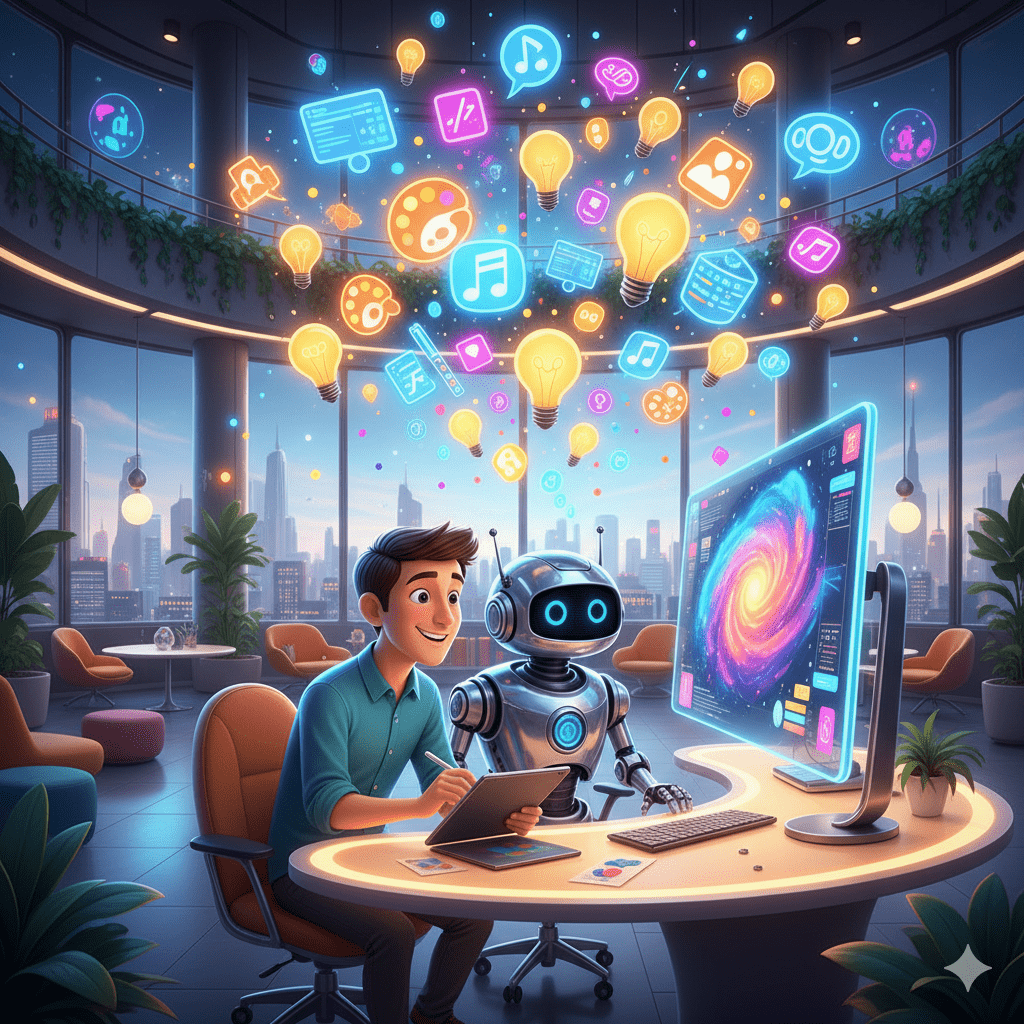
This is where AI and creativity merge. The AI doesn’t have the idea, the vision, or the taste. You do. The AI just helps you get there faster. This process is called creative workflow automation. It’s not about replacing human creativity; it’s about amplifying it.
For example, a marketing team could use an AI to:
- Write 10 different versions of an ad.
- Create a social media calendar for a month.
- Draft an email newsletter.
- Generate images for a blog post.
But none of this happens if you just say, “Write a marketing email.” The result will be boring and generic.
You need a prompt engineer to say, “Act as an expert email marketer. Write a 150-word email to our customers who haven’t shopped in 6 months. Use a friendly and slightly humorous tone. Offer them a 15% ‘We Miss You’ discount, and make sure the main call-to-action is a single button that says ‘Shop Now’.”
See the difference? The quality of the output is 100% dependent on the quality of the input. That’s why prompt careers are becoming so valuable.
Real-World Examples: Who is Hiring for Prompt Careers?
This isn’t just a theory. Big companies are already hiring for roles like “Prompt Engineer,” “AI Content Specialist,” and “Generative AI Editor.” Let’s look at a few examples of how this works in the real world.
- The Ad Agency (Creative Workflow Automation)
- Who: A global advertising agency like Ogilvy.
- How they use prompting: When pitching a new campaign for a soda brand, the creative team needs to show 10 different “mood boards” or visual concepts. In the past, this would take weeks. Now, a “Prompt Artist” uses AI tools like Midjourney or DALL-E 3. They write detailed prompts like, “Create a photorealistic image of a diverse group of friends laughing on a sunny rooftop in Brooklyn, holding retro-style soda bottles. The lighting should be warm, like the ‘golden hour’ just before sunset. Cinematic, joyful, 35mm film style.”
- Result: They can generate hundreds of high-quality concept images in a single afternoon, allowing them to refine their vision and pitch to the client faster than ever before. This is human-AI collaboration for creators in its purest form.
prompt careers
- The Tech Company (Software Development)
- Who: A software-as-a-service (SaaS) company like HubSpot or even Google.
- How they use prompting: Developers use AI assistants like GitHub Copilot. They write a comment in their code (a prompt) that says, “//Create a Python function that takes a user’s email, validates it, and adds it to the database.” The AI then generates the entire block of code.
- Result: The developer’s job isn’t gone. Their job is now to review and integrate that code, and to write even more complex prompts for the next piece of the puzzle. It speeds up development time dramatically.
- The Small Business (Content Marketing)
- Who: Remember Maya, our graphic designer? Let’s see how she’s doing.
- How she uses prompting: Maya now offers “AI-Enhanced Branding Packages.” She uses ChatGPT to brainstorm brand names, slogans, and blog post ideas for her clients. Then, she uses Midjourney to create 5 different logo concepts based on her client’s vision. She refines the best one by hand in Adobe Illustrator.
- Result: Maya can now do the work of a small agency all by herself. She’s not just a designer anymore; she’s a creative director, using AI to execute her vision. Her prompt career has allowed her to triple her income while working on more creative projects.
How to Start Your Own Prompt Career (Even With No Experience)
The best part about prompt careers is that the barrier to entry is low. You don’t need a 4-year computer science degree. You need curiosity, creativity, and a willingness to learn.
Here is a simple, 4-step workflow to get started.
Step 1: Pick Your Playground You can’t learn to swim without getting in the water. Start using AI tools today. Most have free versions.
- For Text & Ideas: Start with ChatGPT (OpenAI) or Gemini (Google).
- For Images: Try Midjourney (it has a learning curve but amazing results) or DALL-E 3 (built into ChatGPT Plus and Microsoft’s Copilot).
Step 2: Learn the “Anatomy” of a Great Prompt A good prompt is clear, specific, and provides context. Think of these four parts:
- Role: Tell the AI who it is. “Act as a friendly, expert travel agent.”
- Task: Tell it what to do. “Create a 5-day itinerary for a first-time visitor to Tokyo.”
- Context: Give it the details. “I am a 30-year-old solo traveler on a budget. I love food, history, and art. I do not want to go to theme parks.”
- Format: Tell it how to deliver the answer. “Please provide the answer as a day-by-day bulleted list with estimated costs for each activity.”
prompt careers
Step 3: Practice and Iterate Your first prompt will probably be bad. That’s okay! The real skill is refining it.
- Bad Prompt: “Write a blog post about dogs.”
- Good Prompt: “Write a 500-word blog post about the benefits of crate training a new puppy. Use a warm and reassuring tone for new dog owners. Include a short intro, 3 main benefits, and a concluding summary.”
See how the second prompt guides the AI to a much more useful result? This is the core skill of all prompt careers.
Step 4: Build a Portfolio You don’t need a job to get experience. Create a personal project.
- Marketer? Use AI to generate a full marketing campaign for a fictional product. Save your prompts and the results.
- Writer? Use AI to co-write a short story or a series of poems.
- Artist? Use AI to create a stunning series of images based on a single theme, like “cyberpunk castles.”
Document your process. Show how your prompts improved the output. This is what you will show potential employers.
Essential Tools for Your New Prompt Career
While there are hundreds of tools, a few platforms are leading the way. Getting good at these is a great place to start.
- ChatGPT (OpenAI): The all-purpose tool for text. It’s fantastic for brainstorming, writing drafts, summarizing long documents, and even helping you write code.
- Midjourney: The king of AI image generation. It’s known for creating beautiful, artistic, and highly detailed images. It operates through the Discord app, but don’t let that scare you.
- Jasper.ai: A powerful AI writing assistant built specifically for marketing and business. It has templates for everything from blog posts to social media updates, making creative workflow automation incredibly simple.
- GitHub Copilot: If you’re a programmer, this is your new best friend. It integrates directly into your code editor and suggests entire lines or blocks of code as you type.
The Future of Work: Human-AI Collaboration
It’s natural to be worried about AI. But history shows that technology doesn’t just destroy jobs—it changes them. The Industrial Revolution didn’t end work; it created new jobs like factory managers, mechanics, and electricians.
AI is doing the same. As a landmark report from McKinsey & Company points out, generative AI will reshape work, automating some tasks but, more importantly, augmenting human capabilities. We are moving toward a future built on human-AI collaboration for creators.
The people who will be most successful in this new era are those who embrace AI as a partner. The best writer won’t be an AI; it will be a human using an AI, as explained by the Harvard Business Review. The best designer won’t be a machine; it will be a human directing a machine.
Prompt careers are the bridge between human ideas and artificial intelligence. By learning this skill, you’re not just learning to use a new piece of software. You’re learning the language of the future. You’re becoming the essential human element that guides technology, infuses it with creativity, and directs its power.
So, don’t be afraid of the blank page or the empty prompt box. See it as an opportunity. Your next great idea is just one perfect prompt away.