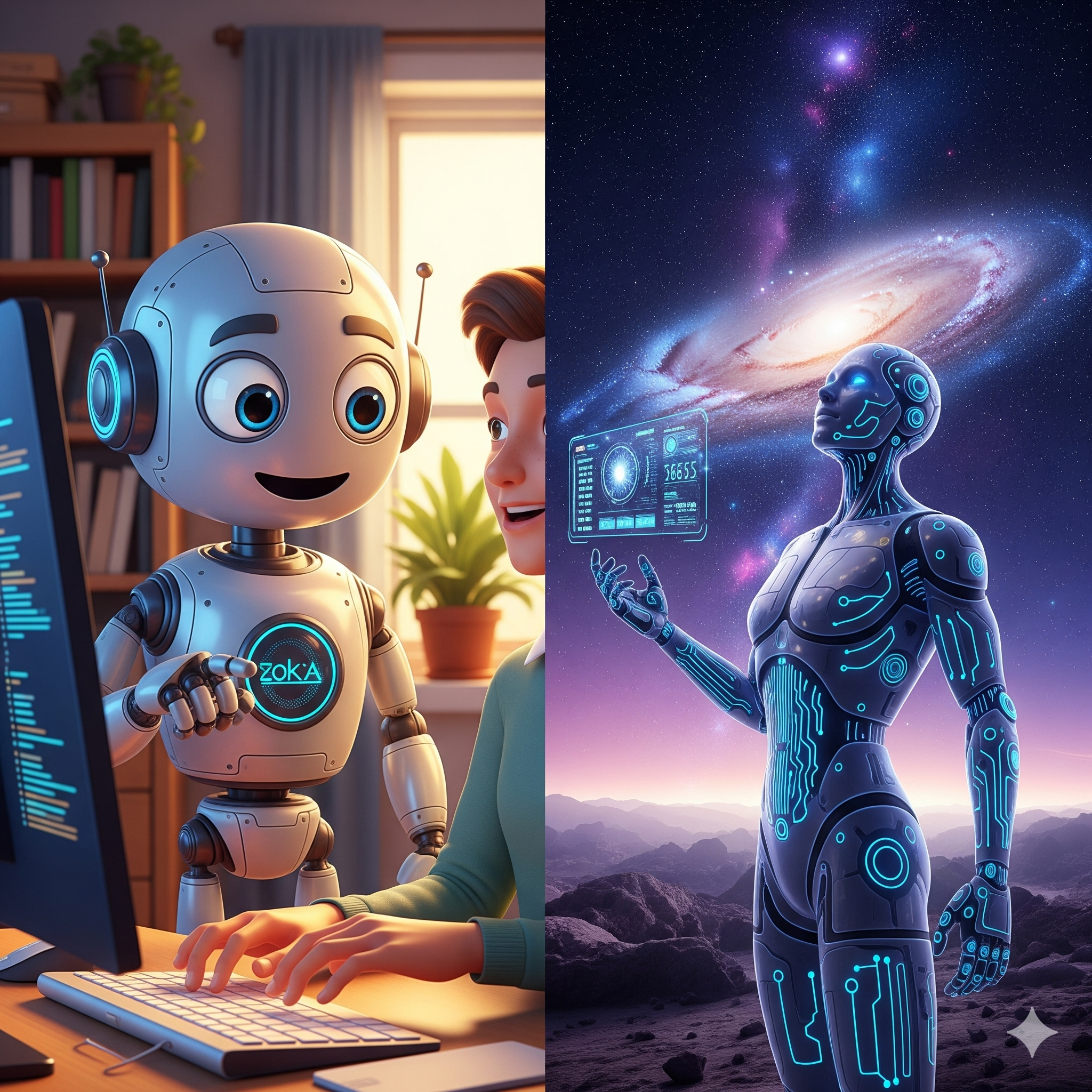
Have you ever wondered if your smartphone is actually smart? Or if the robots in movies are ever going to become real? (Strong AI and Weak AI Examples)
Imagine you have a calculator. It is amazing at math. It beats you every time. But if you ask that calculator, “How was your day?” or “Do you feel sad?”, it stays silent. It’s a tool, not a living thing.
This is the perfect way to start understanding the confusing world of Artificial Intelligence. You hear terms thrown around all the time, but today, we are going to break it down. We will explain strong ai and weak ai examples in a way that even a ten-year-old can master. Plus, we will dive into cool stuff, like how to create BGMI with AI, and how you can use human-AI collaboration for creators to become a superhero in your own work.
Sit back, relax, and let’s explore the story of machines.
What is Weak AI? (The Smart Tool)
First, let’s talk about the AI we use every single day. This is called “Weak AI,” or sometimes “Narrow AI.”
Don’t let the name fool you. It isn’t “weak” because it is bad at its job. It is called weak because it is only good at one specific thing.
Think of a champion chess player. They are a genius on the chessboard. But if you ask them to cook a gourmet meal or perform open-heart surgery without any training, they might struggle. Weak AI is like that chess player. It is programmed to do one task perfectly, but it has no clue about anything else.
Why is it “Weak”?
It has no feelings. It has no consciousness. It doesn’t know why it is doing what it is doing; it just follows instructions.
For instance, when you ask your phone for directions, it calculates the route using math. It doesn’t “know” what a road is, or what a car is. It just processes numbers.
What is Strong AI? (The Sci-Fi Dream)
Now, let’s flip the coin. Strong AI, also known as Artificial General Intelligence (AGI), is the stuff you see in movies.
Strong AI would be a machine that has a mind of its own. It could learn anything a human can learn. It could solve puzzles, write beautiful poetry because it feels sad, or crack jokes because it finds them funny.
If Weak AI is a calculator, Strong AI is a human brain made of metal and code.
The Big Difference
Currently, Strong AI does not exist. We haven’t built it yet. We are working hard on AI and creativity, but a machine that actually “thinks” is still a dream for the future.
Strong AI and Weak AI Examples: The Ultimate Breakdown
To really get this, we need to look at specific strong ai and weak ai examples. This list will help you spot them in the real world (and in your imagination).
Examples of Weak AI (Here Right Now)
These are the helpers running our world today:
- Siri and Alexa: These voice assistants seem smart. However, they are just searching a database for answers. If you ask a question they aren’t programmed for, they get confused.
- Email Spam Filters: Do you notice how junk mail automatically goes to the trash? That is Weak AI. It reads the email, spots patterns, and sorts it.
- Self-Driving Cars (Tesla): This is controversial, but currently, it is advanced Weak AI. It recognizes stop signs and lanes, but it doesn’t “think” about the ethics of driving.
- Netflix Recommendations: When Netflix says, “Because you watched Batman, you might like Superman,” that is a math formula (Weak AI) predicting what you want.
Examples of Strong AI (The Future)
Since these aren’t real yet, we have to look at fiction to find strong ai and weak ai examples:
- Data from Star Trek: He looks human, acts human, and tries to understand emotion. He can solve any problem, not just one.
- Wall-E: The little robot who falls in love. That is Strong AI. He has a personality and makes choices based on feelings.
- The Terminator: A scary example! A machine that decides on its own to fight humans.
Therefore, when you search for strong ai and weak ai examples, remember: if it’s real, it’s usually Weak. If it feels, it’s Strong.
How to Create BGMI with AI: The Future of Gaming
Now, let’s switch gears to something exciting. Many gamers ask, “How can I build a game like Battlegrounds Mobile India (BGMI)?”
Creating a massive game like BGMI used to take hundreds of people years of work. However, creative workflow automation is changing the game. Here is how to create BGMI with AI concepts (or how developers are doing it right now).
1. Building the World (Procedural Generation)
Imagine drawing every single tree in a giant forest. It would take forever! Instead, developers use AI tools. They tell the AI: “Make a forest with 10,000 pine trees and a river.” The AI builds it instantly. This is a prime example of AI and creativity working together.
2. Smarter Enemies (Bots)
In BGMI, you sometimes fight bots. In the past, bots were stupid. They just ran at you. Now, developers use human-AI collaboration for creators to train bots. These AI bots learn from real players. They learn to hide, flank, and shoot like pros.
3. Upscaling Graphics
Do you want your game to look realistic? AI tools can take a blurry image and make it super sharp (4K). This helps small teams make games that look like big budget blockbusters.
So, while you can’t just press a button and “make BGMI” yet, you can use creative workflow automation tools like Unity Muse or scenario.com to generate assets, code, and landscapes in minutes.
Human-AI Collaboration for Creators: A New Era
Many people are scared that AI will take their jobs. But let me tell you a secret: AI is not a replacement; it is a partner. This is the era of human-AI collaboration for creators.
The Writer’s Block Breaker
Imagine you are writing a story but get stuck. You can ask an AI, “Give me 10 ideas for a villain.” It gives you lists. You pick the best one and write the story. The AI is the assistant; you are the boss.
The Art Assistant
Graphic designers use tools like Midjourney. They don’t just say “make a logo” and quit. They use the AI to generate 50 ideas in 5 minutes, pick the best concept, and then refine it. This speeds up creative workflow automation massively.
Consequently, the creators who win in the future won’t be the ones who fight AI. It will be the ones who master human-AI collaboration for creators.
Real-World Case Studies: AI in Action
To prove this isn’t just talk, let’s look at three real-world examples of strong ai and weak ai examples and technologies transforming business.
1. Spotify (The DJ in Your Pocket)
- The Problem: People have too much music to choose from.
- The AI Solution: Spotify uses Weak AI to analyze what you listen to. It compares your taste with millions of other users.
- The Result: The “Discover Weekly” playlist. It feels like magic, but it keeps millions of users subscribed.
2. Adobe Photoshop (Generative Fill)
- The Problem: Editing photos is hard and takes time.
- The AI Solution: Adobe added Firefly AI. Now, you can circle an empty table in a photo, type “add a vase of flowers,” and it appears.
- The Result: Massive creative workflow automation. Designers save hours of work every day.
3. Duolingo (Personalized Learning)
- The Problem: Everyone learns differently.
- The AI Solution: Duolingo uses AI to track where you make mistakes. If you are bad at verbs, it gives you more verbs.
- The Result: It feels like a personal tutor, keeping users engaged longer.
Top 5 AI Tools You Need to Try
If you want to experience AI and creativity yourself, check out these tools. They are great examples of advanced Weak AI helping humans.
- ChatGPT: The king of text. Use it for coding, writing, or brainstorming.
- Midjourney: Creates mind-blowing art from text descriptions. Perfect for designers.
- Canva Magic Studio: great for creative workflow automation. It resizes designs and writes text for you.
- GitHub Copilot: For the coders. It predicts the code you want to write next.
- Leonardo.ai: excellent for game assets (like if you are figuring out how to create BGMI with AI style characters).
Conclusion: The Future is Yours
We have covered a lot today. We looked at the difference between the calculator in your pocket and the robots in movies through strong ai and weak ai examples. We saw how game developers are using creative workflow automation to build the next generation of games.
Most importantly, we learned that human-AI collaboration for creators is the key to success.
Don’t be afraid of the “Strong AI” of the future. Focus on mastering the “Weak AI” of today. Whether you are a writer, a gamer, or a business owner, these tools—and resources like these marketing AI books—are here to help you win.
So, what will you create today?