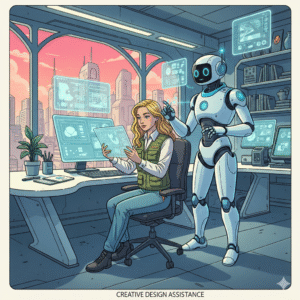
Once upon a time, a marketer named Maria felt stuck. She had a great idea for a new ad campaign, but she was struggling to write the copy. Although she knew the message and her audience, every time she sat down to write, her mind would go blank. She felt a lot of pressure, consequently, she knew she had to get this campaign right. She had heard a lot about AI. So, she decided to try it. She typed a simple prompt into an AI tool: Write me an ad for a new pair of running shoes. The AI gave her a generic, boring ad. It was not what she wanted. It was not creative, and it was not personal. In short, it was a waste of time. She felt even more frustrated, so she thought AI was useless. (AI prompt for marketing)
But Maria was wrong. She just didn’t know how to talk to the AI. She needed to learn a new skill: how to write effective AI prompts. This is a skill that is changing how marketers work. It’s about being a good boss to your AI. It’s about giving it clear, specific, and detailed instructions. This article is your guide to learning that skill. We’ll show you how to turn your AI from a simple tool into a powerful partner. We’ll also look at how real companies are using AI to get ahead. By the end, you will be ready to craft the perfect prompt for any marketing task. You will also be able to get exactly what you want from your AI.
The Three Golden Rules: Clarity, Context, and Constraints (AI prompt for marketing)
When you write a prompt, you only need to remember three simple rules. Following these rules will help you get a great result every time. The three rules are: Clarity, Context, and Constraints.
Rule 1: Clarity
Clarity is the most important rule. You need to be very specific about what you want. A vague prompt will give you a vague answer. In fact, a study by MIT found that the clarity and precision of a prompt have a huge impact on the quality of the AI’s response.
Bad Prompt: Write about running shoes. Good Prompt: Write a 200-word ad for a new line of running shoes. The tone should be friendly and casual. The target audience is beginner runners who are just starting out. The ad should focus on how the shoes make running more comfortable and fun.
See the difference? The second prompt gives the AI all the information it needs. It knows the topic, the word count, the tone, and the audience. Consequently, this helps the AI give you a much better and more useful answer. The more details you provide, the better the result will be.
Rule 2: Context
Context is all about giving the AI background information. This helps the AI understand what you are asking it to do. Therefore, you should think of it like giving a new employee all the information they need to do their job well. It’s especially important for an AI prompting guide.
Here are two ways to provide context:
- Assign a Role: You can tell the AI to act as a specific person. For example, tell it to be a “marketing expert” or a “travel blogger.” This helps the AI use the right language and tone.
- Provide Examples: You can show the AI what you want. If you want it to write in a certain style, give it an example of that style. This is a great way to train the AI.
A marketing team used this rule to make sure their AI-generated content was on-brand. They fed the AI a document with their company’s brand voice and style guidelines. Then, the AI was able to create content that was consistent with the brand. This is a great example of how to write good prompts for business.
Rule 3: Constraints
Constraints are the rules or limits you give the AI. This tells the AI what to include and what to leave out. Using constraints helps you get a more focused and polished result. It also helps you avoid long, rambling answers.
Here are some ways to use constraints:
- Set a word count: You can tell the AI to write a certain number of words or sentences.
- Specify the format: Tell the AI to use a numbered list, a bulleted list, or a table.
- Define what to avoid: You can tell the AI what words or ideas to stay away from.
For instance, a writer used an AI to write a job description. She told the AI to write a description that was less than 200 words. She also told it to use a professional tone and to avoid jargon. In this way, the AI was able to follow all of her instructions. This saved her a lot of time and effort.
AI for Content Ideation: Overcoming Creative Block
Every marketer has faced creative block. It’s that moment when you need a new idea, but nothing comes to mind. This is where AI for content ideation becomes your new best friend. It acts like a brainstorming partner that never gets tired.
Here is how AI can help you with content ideation:
- Find New Ideas: You can give an AI a simple topic. For example, “How to save money on groceries.” The AI will then give you a list of great ideas. It can suggest blog post titles, outlines, and even social media captions. This helps you get a strong starting point for your content.
- Brainstorming: You can ask the AI to brainstorm with you. For example, you can say, “I need to come up with a name for a new coffee shop. Give me a list of 20 names that are unique and memorable.” The AI will give you a list of names. You can then pick the best one and make it your own.
- Content Repurposing: A great piece of content can be used in many ways. A long blog post can be turned into a few social media posts or a video script. An AI can help you do this instantly. This helps you get more value from your content.
This is a great example of how AI can be used to plan your content. It helps you save time and also helps you create a smarter content plan.
AI for Copywriting: Your Creative Partner
Copywriting is the art of writing text that makes people want to buy something. It’s a very important skill for a marketer. But it can be hard to write a lot of good copy. This is where AI for copywriting becomes a huge asset. It is like having a writing assistant that can write a perfect ad for you.
Here is how AI helps with copywriting: (AI prompt for marketing)
- Writing First Drafts: Once you have an idea, the AI can help you write the first draft. You can give it an outline, and it will write a full article for you. The AI can write in different tones, from professional to friendly. This gives you a great starting point. Consequently, you can then go back and add your own personal touch to the content.
- A/B Testing: A/B testing is when you show two different versions of an ad to people to see which one performs better. AI can run these tests for you much faster than a human could. It then tells you which ad is the winner. This helps you get better results from your campaigns.
- Writing Headlines: A great headline is the key to getting people to read your content. An AI can help you write a great headline. It can write a few versions for you. You can then pick the best one.
This is a very powerful way to grow your business. It helps you find more customers. It also helps you win more sales.
Real-World Applications of AI for Marketing (AI prompt for marketing)
Many companies are already using AI to get ahead in marketing. These real-world examples prove that AI prompt for marketing is not just a theory; it’s a powerful tool.
Case Study 1: WPP and Generative AI WPP, a large marketing and advertising company, was spending a lot of money on creating commercials. They had to fly a film crew to different locations, which was very expensive. Therefore, they decided to use AI instead. They used AI to virtually recreate environments for their commercials. They were able to make commercials that were just as good as the ones they made with a film crew. This saved them a lot of money. It also helped them be more creative. WPP’s CEO said this approach delivered cost savings of “10 or 20 times” compared to traditional methods.
Case Study 2: Salesforce’s AI-Powered Marketing Salesforce is a very popular marketing and sales platform. They have added a lot of AI features to their products. Their AI, called “Einstein GPT,” can help marketers with things like creating content and sending personalized emails. It can also help salespeople with their lead scoring. Salesforce’s AI is built to work with a company’s existing data. This helps a team get more value from their data. It also helps them be more efficient.
Case Study 3: The Small Business Owner’s AI Plan A small business owner was struggling to create social media content. She was spending a lot of time trying to come up with new ideas. Consequently, she decided to use an AI content planning tool. She would give the AI a simple prompt. The AI would then give her a lot of ideas for social media posts. This saved her a lot of time, and she was then able to create more content. Her social media engagement went up. This shows that a smart AI implementation strategy is not just for big companies. It’s also for small businesses.
Top AI Tools for Your Marketing in 2025
The market is full of fantastic tools that can supercharge your marketing. Here are a few to get you started.
- HubSpot: This is a very popular marketing platform with a lot of AI features. Its AI, called “Breeze,” can help you with your content strategy. It can also help you write emails and create social media posts. This is a great tool for any marketer.
- Jasper: This is a very popular AI writing tools platform. It is great for creating long-form content like blog posts and social media copy. Jasper is also good at writing in your unique brand voice.
- Writesonic: This tool is great for a marketer who wants to use AI. It uses AI to send emails at the perfect time for each person on your list. This is a great way to get more people to open your emails.
- Crayon: This tool uses AI to help you with your competitive analysis. It can tell you what your competitors are doing. It can also tell you what they are doing well. This helps you get an edge in the market.
These tools are at the forefront of AI prompt for marketing. They can help you take your sales and marketing to the next level.
Conclusion: The Future of Marketing is Human-Powered
The future of marketing is not about AI replacing people. It is about a partnership between humans and AI. The AI handles the mundane tasks. The human handles the creative, emotional, and strategic parts of the job. This is the new reality of the marketing world.
A McKinsey report states that AI is a tool that helps people be more productive. It is not a replacement for human creativity. The most successful companies will be the ones that redesign their workflows to include AI. By embracing this technology, you can be more productive, more creative, and more valuable. This will help you get ahead in the market and drive more revenue for your business. (AI prompt for marketing)
Links: AI for Sales and Marketing: The Secret to Driving Revenue
AI Literacy for Students: Why It’s the New Math