In 1882, Thomas Edison flipped a massive switch in lower Manhattan, illuminating just 400 incandescent lamps. That single, quiet action forever altered the trajectory of American industry. We are currently standing at an identical, pivotal inflection point in history. However, instead of electricity, cognitive computing power is the new baseline utility. You are likely watching your domestic competitors radically accelerate their operations, leaving you deeply frustrated and wondering how to catch up without breaking your operational budget.
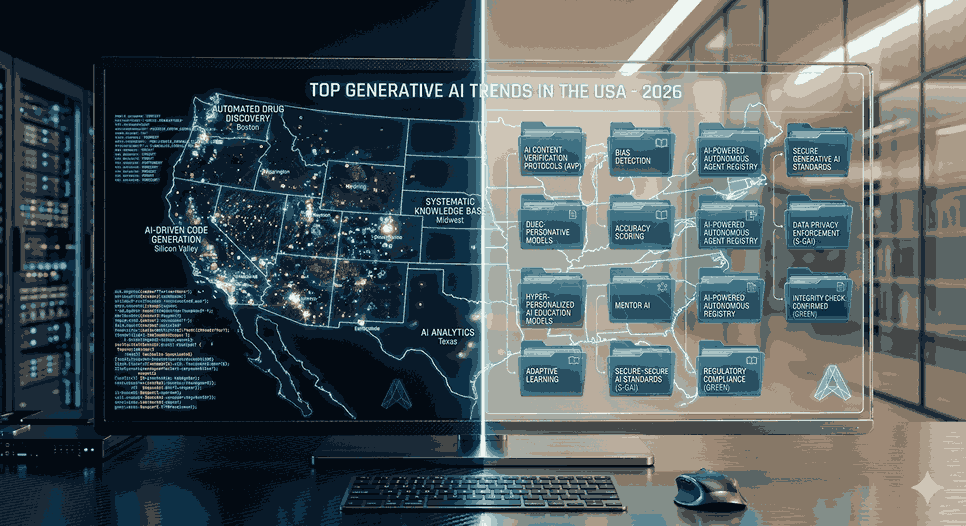
Understanding the top generative ai trends in the usa for 2026 is absolutely vital for your company’s immediate survival. The era of treating artificial intelligence as a quirky experimental toy is officially over. By the end of this comprehensive guide, you will know exactly how American enterprises are actively deploying these models to drive massive revenue. Furthermore, you will learn the precise, actionable steps to integrate these powerful digital trends into your own daily workflow safely and securely.
The New American Grid: Contextualizing AI Adoption
To truly grasp the magnitude of this technological shift, we must simplify the core concept using a highly relatable comparison. Think of artificial intelligence no longer as a standalone software application, but rather as a brand new electrical grid being laid across the country. Ten years ago, companies bought software to solve one specific problem. Today, companies are plugging their entire organizational infrastructure directly into the generative AI grid.
Just as electricity powers your refrigerator, your office lights, and your factory machinery simultaneously, generative models now universally power human resources, financial forecasting, and creative marketing. For example, a mid-sized firm does not just buy a chatbot; they integrate an underlying cognitive layer that reads their emails, drafts their contracts, and optimizes their supply chain. Tracking the top generative ai trends in the usa for 2026 requires recognizing this shift from isolated “tools” to deeply integrated “infrastructure.” Up next, we will dive deep into the specific mechanical nuances driving this massive corporate transformation across the nation.
Deeper Dive: The Mechanics of the Artificial Intelligence USA Boom
Going deeper into the mechanics, it becomes glaringly obvious that the current technology landscape is fiercely competitive. You must actively engineer your business strategy to leverage these highly distinct, evolving capabilities. Therefore, mastering the top generative ai trends in the usa for 2026 requires breaking down the exact architectural shifts dominating Silicon Valley and beyond.
Here are the foundational elements driving the American artificial intelligence boom this year:
- The Rise of Agentic AI Frameworks: We are moving rapidly past passive chatbots. Companies are deploying autonomous AI agents that can actively book flights, execute financial trades, and negotiate vendor contracts entirely without human intervention.
- Hyper-Localized Small Language Models (SLMs): Massive corporations are abandoning giant public models due to deep data privacy fears. Instead, they are training highly efficient, smaller models strictly on their own proprietary, localized servers.
- Multimodal Synthesis Dominance: The barrier between text, audio, and video has completely collapsed. Systems can now watch a live security camera feed and instantly generate a written, legally compliant incident report in real-time.
- Zero-Click Marketing Ecosystems: Because platforms like Google’s AI Overviews and ChatGPT natively answer user questions, American marketers are drastically shifting budgets from traditional SEO toward Answer Engine Optimization (AEO) to capture this new synthetic traffic.
What are the biggest AI trends in the US regarding data privacy?
To successfully navigate this landscape, you must understand what are the biggest AI trends in the US regarding data privacy. Currently, strict federal and state regulations are forcing companies to adopt “Air-Gapped AI.” This means the artificial intelligence operates entirely offline, completely disconnected from the public internet. By utilizing decentralized, localized servers, American healthcare and financial institutions can securely process highly sensitive patient or client data without ever risking a catastrophic public cloud leak.
Real-World Applications: How Generative AI is Changing American Business
Let us ground this heavy technical theory in absolute, measurable reality. How are highly successful American companies actually navigating these conflicting strategies? Consider a massive regional hospital network in the Midwest. They historically struggled with severe emergency room bottlenecks. Recently, they aggressively shifted toward predictive generative modeling. According to a comprehensive benchmark report by McKinsey & Company, generative AI could add up to $4.4 trillion annually to the global economy.
Knowing this, the hospital utilized AI to actively analyze five years of patient intake data alongside real-time local weather patterns. As a result, the system now accurately predicts daily patient surges, automatically adjusting nurse staffing schedules 48 hours in advance. Their average wait times plummeted by an astonishing 35%.
In stark contrast, consider a boutique financial advisory firm in New York. They realized that when high-net-worth clients ask complex tax questions, they demand immediate, perfectly accurate synthesis. The firm deployed a secure, custom-trained instance of ChatGPT Enterprise. Consequently, when an advisor needs to compare three different complex trust structures, the AI exclusively cites current IRS tax codes and the firm’s proprietary wealth strategies. This specific application of the top generative ai trends in the usa for 2026 drastically reduced their client response time from three days to just under four hours.
Step-by-Step Workflow for Enterprise AI Adoption
You cannot simply buy a corporate software license and expect your team’s productivity to magically double overnight. Adapting to these new frameworks requires a highly proactive, structured approach to internal training. Here is a clear, beginner-friendly workflow to fundamentally upgrade your organization’s digital workflow today.
First, strictly identify your most repetitive internal bottlenecks. Do not try to automate your overarching corporate strategy; instead, target the mundane data-entry tasks draining your team’s energy. Next, establish a highly rigid internal AI usage policy. You must explicitly tell your employees exactly what sensitive client data they are legally forbidden from pasting into public language models.
Then, launch a localized pilot program with just one specific department, such as customer support or content marketing. After that, rigorously measure the time saved and the quality of the output against your historical human baseline. Finally, once the pilot is deemed successful, aggressively scale the software across the entire company while appointing dedicated “AI Champions” to continuously train staff on the latest prompt engineering techniques.
Best practices for generative ai trends in the usa impact on jobs
If you want to maintain high team morale, you must carefully manage the generative ai trends in the usa impact on jobs. The absolute best practice is transparent “job augmentation” framing. You must explicitly demonstrate to your employees that the AI is not there to replace them, but rather to eliminate their most hated administrative chores. When workers realize the technology frees them up to focus on high-level, creative strategy, their initial fear rapidly transforms into enthusiastic adoption.
Essential Generative AI Tools for US Companies
Building a highly reliable, modern tech stack is absolutely critical if you wish to successfully navigate this massive corporate transition. You can no longer rely purely on legacy software systems. Here are four essential resources you must immediately integrate into your daily workflow to capture the top generative ai trends in the usa for 2026:
- ChatGPT Enterprise: This platform is fundamentally changing how professionals communicate. It offers enterprise-grade security, meaning OpenAI does not use your private company data to train their public models, making it the absolute gold standard for corporate use.
- Anthropic Claude 3.5 Sonnet: Claude is undeniably the best tool for processing massive, complex documents. If your legal team needs to summarize a 500-page vendor contract instantly, this platform’s incredibly large context window handles it flawlessly.
- Microsoft Copilot for Microsoft 360: Because this tool integrates natively into Word, Excel, and Teams, it dramatically lowers the learning curve for non-technical employees. It acts as a seamless digital assistant sitting directly inside the software your team already uses daily.
- Midjourney (v6): For American marketing and design agencies, this image generation model remains entirely unmatched. It produces hyper-realistic, commercially viable campaign imagery in seconds, drastically reducing the reliance on expensive traditional stock photography.
Common Myths About Generative AI Impact
Whenever a highly disruptive technological shift occurs, dangerous myths frequently cloud the business industry’s perception. Let us decisively address and correct the most common misunderstandings surrounding AI trends in America so you can operate with total confidence.
Myth: Artificial intelligence will completely replace all human knowledge workers by 2030. Reality: This is a massive, highly pervasive misconception. While AI handles basic data synthesis, it entirely lacks genuine emotional intelligence, physical empathy, and complex strategic negotiation skills. According to the Stanford AI Index Report, AI is mathematically proven to enhance human productivity, not completely eradicate the need for expert human oversight.
Myth: Implementing generative AI requires a massive, multi-million dollar IT budget. Reality: The exact opposite is actually true. Thanks to the rapid proliferation of API access and massive open-source models like Meta’s Llama 3, small American businesses can seamlessly integrate world-class cognitive capabilities into their websites for merely a few hundred dollars a month.
Myth: Everything generated by an AI is immediately safe to publish legally. Reality: AI models still frequently “hallucinate” false information and can inadvertently plagiarize copyrighted material. Therefore, implementing a mandatory “Human-in-the-Loop” review process is absolutely non-negotiable before deploying AI-generated content to your public-facing American consumers.
FAQ Section — Future of Artificial Intelligence USA
What exactly are the top generative ai trends in the usa for 2026?
The dominating trends include the rapid shift from public cloud AI to highly secure local small language models (SLMs), the massive rise of autonomous agentic workflows that execute physical tasks, and the aggressive optimization of marketing content for zero-click generative AI overviews.
How is AI changing the traditional American search engine landscape?
It is completely fracturing it. Because tools like ChatGPT and Google’s AI Overviews directly synthesize and answer user questions immediately, traditional website traffic for basic informational queries is plummeting. Consequently, brands must pivot to Generative Engine Optimization (GEO) to ensure they are explicitly cited as sources within these new AI summaries.
What are the best generative AI tools for US companies just starting out?
For seamless integration, Microsoft Copilot is exceptional because it lives natively inside familiar Office applications. And, For deep, complex reasoning and coding, ChatGPT Enterprise is highly recommended. For massive document analysis, Anthropic’s Claude is currently leading the industry.
Is generative AI actually secure enough for American healthcare and finance?
Yes, but only if deployed correctly. You absolutely cannot paste HIPAA-compliant medical data or SEC-regulated financial data into public, free AI chatbots. Healthcare and finance sectors must utilize enterprise-grade, SOC 2 compliant models with strict zero-data-retention agreements to remain fully legally compliant.
Difference Between Answer Engine vs Search Engine for SEO
Conclusion
Navigating the incredibly complex transition into the modern cognitive era absolutely does not require panic. By deeply understanding the top generative ai trends in the usa for 2026, you can strategically position your business to thrive in a heavily automated, highly intelligent digital economy. We have thoroughly explored how enterprise adoption is shifting toward secure localized models, how autonomous agents are automating repetitive workflows, and how companies are completely reimagining their digital marketing strategies.
How to Adapt to SEO AEO GEO and AIO Differences in 2026
Therefore, do not let this rapid algorithmic evolution paralyze your daily operational efforts. Treat these advanced cognitive models as highly specialized, tireless digital employees in a much larger, unified commercial strategy. I strongly encourage you to audit your team’s most frustrating, repetitive bottleneck this week. Identify exactly where human energy is being wasted, aggressively apply the specific AI tools we discussed, and watch your business successfully dominate the next generation of American industry.